The red dirt on my feet and grit under my fingernails brought me swiftly into the agricultural life of southern India. Still in Auroville in the fertile green belt, my rapport with the Tamil workers of Kuilapalayam and Bommapalayam became something akin to friendship. The peasants of this state labored in these flatlands since the time of the Mahabarata, coercing oilseeds, fruit trees and drought tolerant vegetables to yield like obedient servants for them. Toiling after the monsoon to reap their livelihood in the forms of mangos, cashews, gram and millet, then replanting after the winter monsoon, to raise papayas and coconuts to the sky, flood the sugarcane and rice patties, and deftly sow grains, lentils, grass and cereals in what was really the overgrown garden of Tamil Nadu.
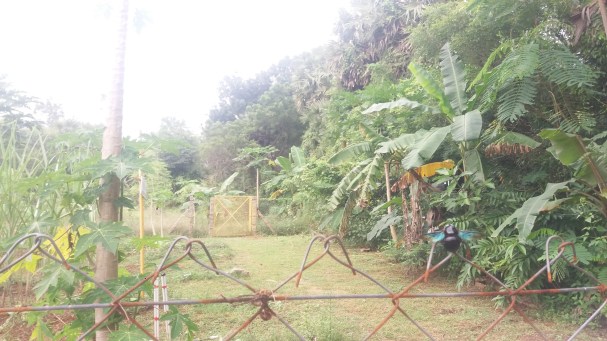
In Auroville I observed an eclectic array of characters who chose to station themselves here and eke out a living or who had come to be part of the action; an old timer Australian in a lungi and turban who had been holding potlucks in the forest for several decades and was something of a legend here, french youth who rode electric bicycles and helped out on fruit orchards, a few Iranian and Persian musicians, a German mountain of a man who lives half the year in Sri Lanka, a permaculture farmer from England named Krishna, and a woman from Sweden who knows kundalini yoga and has been traveling for three years on her own. My reflections became more keen as I learned to differentiate between my own subjective experiences of the journey, and the impressions I could potentially make on the people and places around me.
I rode to a grand Ganesha temple in Whitetown, where supposedly an elephant named Laxmi will bless the temple visitor. Taking the east coast road south, I spotted a cafe called The Motorcycle Diaries, and took a mental note to try the coffee there sometime, and wondered if it had anything to do with Che Guevara. Two friends I picked up in Auroville tailed me to Pondicherry city on their two-stroke bikes. The petrol attendant tried to overcharge us 300 rupees for the fuel and oil, so we make a bit of a scene, and not a single paise was overpaid in the end. The traffic in Pondi was insane, as the city prepared for a visit from the President of India. While back in Auroville, hundreds of stout Tamil men carried bamboo poles, softwood stakes and coconut coir rope down dirt tracks, fastening fences together at an astonishing rate, while their tobacco colored bodies glistened with sweat. Hundreds of guards and police stood around looking bored without anyone or anything to enforce. Teams of ten or twelve of them gather to discuss something, then disperse on their buzzing Honda Heros, unhelmeted and riding pillion, yet the whole premise of it seemed benign and overcompensated.
We find somewhere to park the bikes on a shaded street near the ocean, and forge our way to the temple. Past the men selling beads, and flowers, the woman with chalk, and the autorickshaw drivers hustling rides to Auroville. “Sir, madam, you want good quality, I give you best price.” No thankyou, I came for the holy sights. No elephant stood outside on the sandy cement slab built for it, and a sign reading ‘please do not give any money to Laxmi’ written above it. Laxmi is the goddess of abundance in the Hindu pantheon and was said to bestow blessing and prosperity. It seemed a perfectly appropriate name for a pachyderm. Instead in her absence
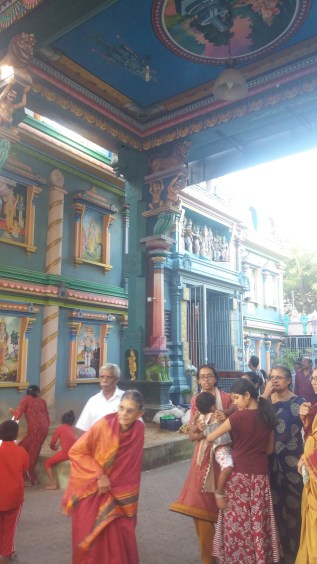
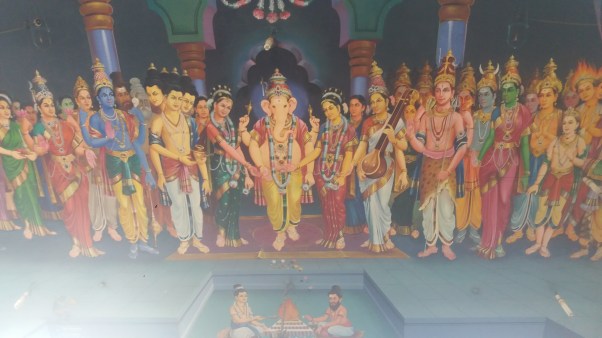
I entered the temple looking for the blessings promised and was met with a mess of signs reading no cell phones or camera permitted. I looked on as several Indians snapped pictures in front of the shrines, and sculptures, while the walls glittered in brass and silver, and every other surface including the roof was painted with historical renditions of the holy Ganesha throughout Asia.
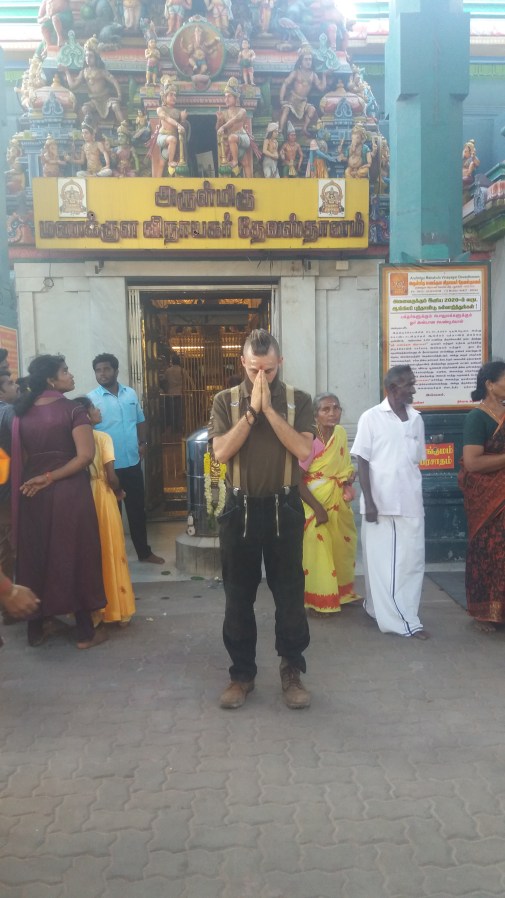
People were lining up, in a long queue like those at carnivals, into a central room no bigger than a closet for their darshan blessing. Another line led into the backside of the room, for a ‘special darshan’. Already the signage had utterly bewildered me, and left me with the confused tourist look. I had not other choice but to join the herd, the heat from all the bodies was intense, and most of the woman were dressed in ochre saris, while the men wore dotis. I realized after thirty minutes what I was waiting for. A Brahmin man extended an arm towards me, holding an oil candle on a tin plate, with a bowl in the other hand filled with white ash. I threw the heat of the flame to my eyes and smeared the ash on my forehead in three strokes. The horizontal lines were for Shiva or Ganesh, while the vertical tilak were for Vishnu. At another table a man offered the red pigments for the central bindu. I officially had experienced a darshan and the temple, but I probably looked fairly odd in its confines, dressed in my German carpenter pants, and collared motorcycle shirt. I should have been wearing my orange temple lungi, or at least a white shirt. The white ash and red powder on my forehead did actually impart something to me. What it was, I don’t know, but there was some energy in it, and made me a little more attuned with the atmosphere of the temple. My spirit didn’t soar, but the feeling wasn’t bad either.
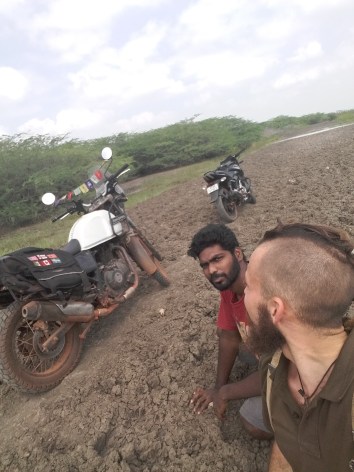
Another day, Monish and I rode out to Kaleveri Lake. I heard rumor of flamingos and other colorful birdsliked to inhabit the mud flats there. After one failed attempt to reach it from the south shore, driving the bikes over clay that had been pockmarked by a thousand hoofprints of cattle and dried in place, we only managed to get past one set of puddles. After watching a mothr cow walk through up to her belly at a slow trod in sticky muck, I decided it was not worth trying with the bike, lest it get bogged down and irretrievable.
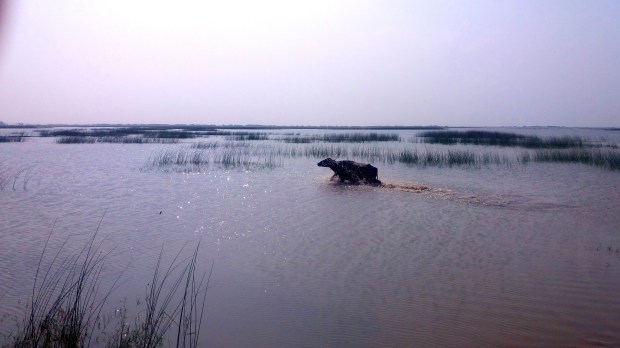
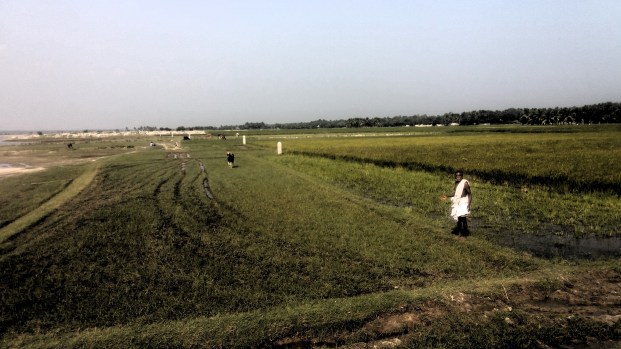
On the following weekend we took the ECR north this time, and cut west to try and reach it through heavily cultivated farmland. We plodded on in single file, through mature rice fields and black lentils tightly packed into the paddy. A woman chased her cow that was eating rice grains right from the plant, then I crouched at the edge of the wetland and contemplated a water buffalo that was bathing in the glinting grey water, while a dark skinned Tamil man wearing a white lungi watched us idly but carefully. The beast tromped through the waters, with one foot tied to a halter round its neck to keep it from going fast. Though from the briskness of its watery stampede, I would still not want to chase it over land.
No flamingos sunned themselves or danced in the shallows, but some interesting nests were hung from the palms. Small weaver birds built their nests under the fanning leaves of aerial vegetation which were strung on cords of twisted grass. Each nest had two or three entrances at the bottom and they swung precariously, barely dangling there in their canopy. A banyan tree hung with plastic bags containing some reeking item of organic matter. Monish told me it was custom for the villagers to put the placenta of their cattle after giving birth up into the banyan, tied on to the vines. They did this to keep them out of reach of dogs, and civid cats presumably. I had seen several of these around Kuilapalayam, and just thought it due to incompetent waste practices, but the regularity of it seemed too extraordinary to be mundane. Was there a hidden rite adjoined to this practice? or some symbolic representation of the placenta and the banyan, or was it just a peculiar custom that happened to be so commonplace in India that my western sensitivity found it archaic.
I decided not to think on it too much, as I have noticed over this journey the more I try to rationalize and fit things into neat explanations with my conditioned mind, the stark reality of the country makes itself more present in the most unexpected and conspicuous manner. Though I consider myself fairly level headed and travel in a manner that upholds cultural sensitivity, it is tantalizing to think of India as a place with real magic, miracles, and the loaded potential of anything happening at any moment. This very truth infuses the air with a kind of exciting energy and arousal for new experiences, while coming with the complete surrender that almost nothing is in your control.
One may just as easily come upon death as one can birth, as I have noticed a lot more puppies and goat kids on the roads and beaches. The sheer human life is another thing that I never really come to fathom. How can there be so many people, while sexuality is so reserved and privacy is almost nil. Where does everyone do it? Today I witnessed a cow being artificially inseminated while it happily chewed its cud, and I stood by drinking hot masali chai with the Tamils on a break from planting beans. Before I finished the brew, the deed was done, and the doctor went off on his motorbike with his empty syringe. I had seen bullocks pulling carts in the streets, while their red and yellow painted horns blazed in the sun, I imagined a few of these also harried the farmers fields, and a kind of nostalgia set in on these geographic coordinates of the world that would hold imprint in my memory forever.
I met a man outside the bakery leaning against a new African trekking bike, but he seemed dull and uninterested to talk, so nothing came of it. My bike has turned many heads in the village, and always the same string of questions follows when I kill the motor. How much does it cost per day for your bike sir? your native place? Do you have a wife? Why not married? How long you will stay in India? What is the average for one tank? By this they mean the distance. Sometimes they are keen to make the point that my bike is not efficient, and I should ride something smaller, more like their avengers or Bajaj. Others love it, and I have met some real Royal Enfield fanatics with vintage bikes who tell me interesting bits about the reputation of the company. I take a lady friend on pillion by night through Edayanchavadi and up the Koot Rood to a potluck at Sadhana Forest. I had known of these folks for years but never made contact. There were easily a hundred people, all eating quietly sitting cross legged on the floor, while someone played the accordion and another woman sang a folky version of ‘Hit the Road Jack, people danced and went for seconds and thirds, there was plenty of food, and good conversation.
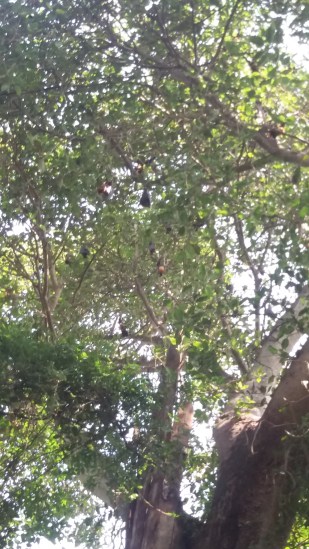 My adventures in Auroville have only been small day trips thus far, out to Pondi and the Tamil villages, including a visit to a bat tree where hundreds of flying foxes slept in the day. Most of the time the bike has sat on the stand, as I find myself at times bound to my hut when the torrential rains fall. I have been itching for the new again, yet I know once I’m back on the crazy Indian roads again, I will be just as excited to reach the next destination. To satiate my hunger, I’ve started to build up an itinerary close which will flip my trip meter closer 10,000 km and take me all the way to Himalchal Pradesh in the North by March. Just doing this relieves some of the restlessness in me and satiates my instinct for adventure, but I am honestly thoroughly enjoying myself on this land, there is a magnetism to it that attracts the forlorn traveler. I can encamp in my forest hut, and wile away the nights hours with whatever I please, reading books, meditating, drinking tea, or writing, yet within minutes on the bike find myself in the center of the action of Auroville. I can go see a film, an exotic music concert, find a tasteful restaurant andeat to my hearts delight. I’m living cheap here, on about 175 rupees all in for my accommodation with lunch and dinner, not including fuel and the occasional luxury. This money cant even buy a latte at the fancy coffee shops back home.
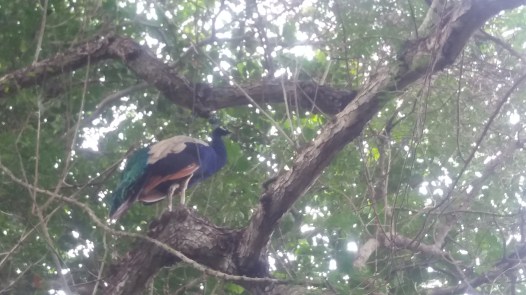
At twilight mongoose stealthy run the paths, peacocks mew in the distance, and jackals hide in the bushes around my hut, while spiders and geckos invite themselves inside voluntarily. I’ve seen some boar prints in the sand, and there are wild cats in the region. Some interesting flowers grow in my vicinity, some resembling yonis, feathers, elegant vases, or stars, all steeped in eros and found in all colors imaginable.
Next week I intend to take a longer ride Tiruvanamalai, to the cave where Sri Ramana Maharshi became enlightened. Its a two hour bike trip from here, and a hike up a mountain that remains a steady pull for pilgrims. As my own guru Ram Dass left the earth just the other day, it will be interesting to see if there are any ceremonies or holy places made for him in India.
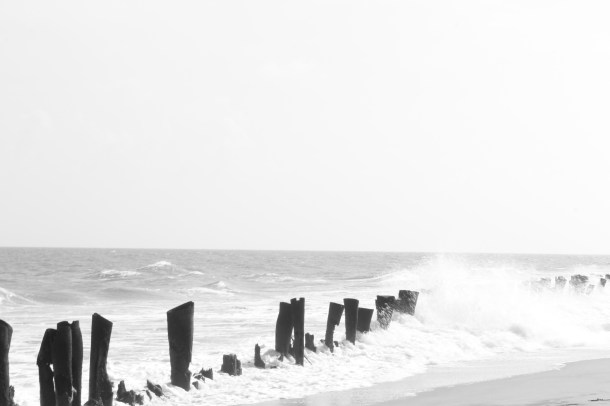
Christmas came and went without too much fuss, and I did not have to suffer through any terrible pop music, or bear witness to gratuitous displays of materialism, but I missed my comrades in Canada. Tonight is the eve of a new year, and people are holding parties and lighting firecrackers in the village, while the real fireworks will explode over the Bay of Bengal. If I had it my way, my night would be shared in the arms a beautiful lady, sipping coconut fenny in the dark of the night.
I find time time when the sun sets to reflect on the year. So many points of reference, rites of passage, setbacks, sub-arctic adventures, resettlement, and a love story that seemed to be written by the Gods themselves. Maybe it was here in India where the intensity of my life could meet its equal, and somehow this country did make my feel like it was all just grace and the everyday experience of being human. At very least, I knew I was really living.

 the motorcycle mantras