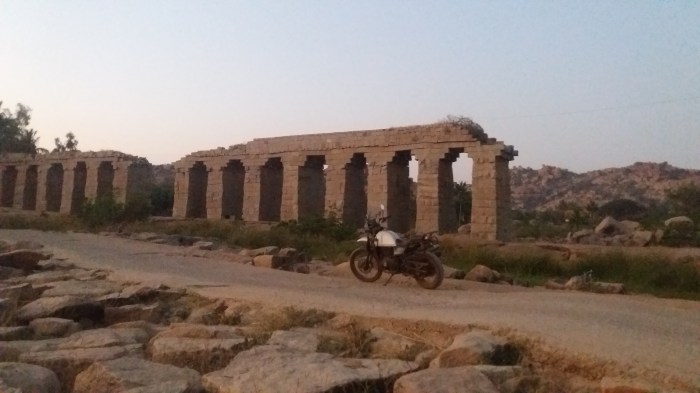
When moving through the world at 80km/h on a motorcycle, there is the simultaneous experience of witnessing so much of the goings on, and yet feeling like you are moving through an endless stream of missed opportunities. This pretty much sums up travel in India, as I cruise through the tapestry of country life that has no expectation of my arrival, and where I have no other prerogative of intention than the pure and direct experience of the felt moment. I could not possibly feed on the entire meal that is fed to me in just a few minutes of riding, and I was told by Indian man this is one reason they believe in reincarnation. The sheer enormity of sensation and possible realities one can subsume is grander than the span of a single human life, another round here on this planet make sense for the eternal traveler. It had some sense to it, and I noticed the battle of emotions that went on in my mind between staying still and getting to know one place intimately, or to keep moving and let the movie play without a pause button. Perhaps I could find a happy medium.
At the birthplace of the monkey God in Hanumanhali I catered to the climber and kid in me, running down boulders on the Tungabhadra river, and exploring Hampi with a careless digression from responsibility. Not that I was irresponsible, but to relinquish any form of schedule or structure in my day felt liberating, and I went about the temple city like Arizona Jones, climbing up cliffs near the Yantrodharaka temple and tracing my hands over the forlorn carvings of an ancient civilization. The motifs and stones themselves spoke in dynamic visual lyrics and depicted such a fantasmagorical display of images that were to me like moments of eternal time captured in history; there were wild quadrapedal beasts beheading men, spiraling trees bearing strange fruit, brahmins or priests in heavy garments, cobra on pedestals, dancers flaunting the nakedness of skin, yogis and sadhus seated in various asanas, tantric lovers and women combing down long hair, and sacred symbols nicked into every edge and crevice.
I stayed in a primitive bamboo hut, walled with woven grass mats near the Pampapati-Tungabhadra river, lit up at night with technicolor lights, an amusing contrast in the most eclectic of places. It had a ceiling fan, and a king size bed, and I paid the peasants sum of 180 rupees a night, so I let myself have three and enjoyed the evening solitude with the ambience of the rapids that lulled beyond my walls. The river was said to be the place where one of Shiva’s wives had lived, and sat on the stones waiting for his return, like maidens of the sea wait for their sailors on widows decks. The boulders themselves seemed to flow as their polished granite and marble surfaces conformed to the routes of the white waters. Pampapati offered up several sanctitudes for nude bathing, so in the privacy of my own wild forays down the torrent, I took great advantage of these prospects and cast my tired aching body into cold pools and the rushing exhilaration of fast flowing clean water. I always emerged feeling like a million bucks.
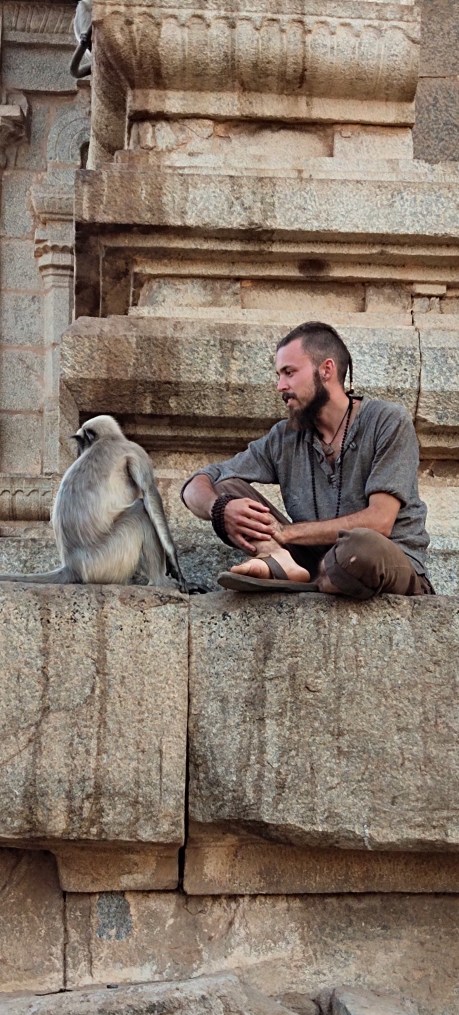
At the Virupaksha temple were hundreds of languors just chilling on the frontiswork, eating bananas and coconuts and often stealing them from the fruit dealers who sat in the shade, selling bushels for 10 rupees. The languors were much larger than the red faced macaques, and in my opinion were far more zen to be around. They had a penchant for darting off in sudden bursts of energy and hopping over the saddles of the lines of parked scooters and two stroke motorbikes near the temple gates, never failing to knock over a few of them, while onlookers set them up again before their owners came back. My own bike was parked upriver on the other side and relatively safe from jumping monkeys and unnecessary damage. One of the females took a great interest in the beads around my wrist while she poked and prodded at them unsure of what function they served or maybe how she might be able to wear them on her own furry wrist. We couched ourselves on the side of the temple in a silent contemplation of each other, and a mutual acceptance of our differences.
I strolled through the Hampi bazaar, in search of a white lungi for later use in the ashram. This was the traditional men’s dress resembling a towel or a kilt wrapped around the hips and draped down over the knees. Orange was the color of Hanuman, and I had difficulty finding other colors of cloth so I decided to wait until the Hyderabad markets to buy one. A boat with an outboard motor was waiting at the ghat for the late passengers, to make the 3 minute crossing of the Tungabhadra. The price was hiked from 20 to 50 rupees after 5pm, so I suffered the tax and made my way back to the other side and cut a deal with a Muslim rickshaw driver to take me back to my quiet hut in Sanapur. We spoke not a word alike, but somehow managed to cohere with each other, and I understood he was a farmer. We talked about the price of vegetables, and I gave him the last of the rupees I carried in my tunic pockets. Western tourists barreled past on scooters and rental bikes, and we left the ‘Hippie Island’ where the night life was just starting to stir. At the Riverside Republic restaurant I dined on steamed momos, and mango lassi while the guys lazily lounged in their calm passivity smoking cigarettes and drinking kingfishers. I retired early with a full belly and a large bed to sprawl in, it was a bed for two but I was happy it was all for me tonight.


In the morning I drank a hot infused tea of saffron, cardamon, clove and cinnamon, what was called a Kashmiri Kawa, and passively made observations of the village life coming alive. Women washed their laundry in the river, the water buffalos contentedly ate their hay, and the chai walas poured heaps of jaggery into hot boiling kettles. Children ran down back alleys and their smiles filled me with joy, it was always such a beautiful way to connect with the people of the land, through the youth and their innocent play. I hopped on the saddle the next day to visit the birthplace of Hanuman at the Kishkinda grounds, where a large whitewashed temple sat on top of a hill of exactly 527 steps. I had a particular favor for Hanuman because he seemed the most wild and heroic of the Hindu gods. His infamous monkey army had built the Ramas bridge in Danushkodi that once connected India with Sri Lanka.
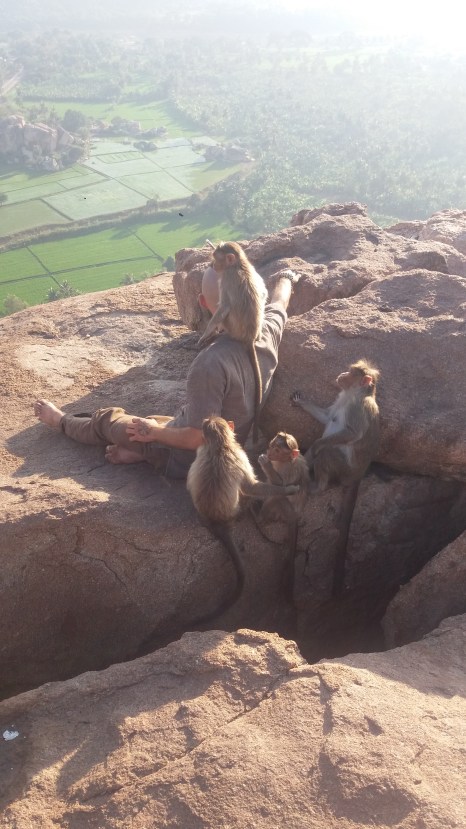
The red faced barbarians at the top were less hostile than usual, and a lot less concerned with my food, though a couple of the youngsters did take great interest in my hair, and sat on my shoulders combing through my scalp with deftly pointed fingers and long brown nails. I watched a mother and father macaque cherish its newborn baby, and two youngsters fooling around on the fence edge. I denied the offers of more selfies from eager cell phone wielding teenagers, and met with some Canadians from Ottawa traveling together from the southern country to Goa, as the simian lookalikes investigated our belongings and begged for water from our flasks. I drank in the views of this antiquated city, fringed with paddy fields, megalithic ruins and the giant sandbox the held it all inside.
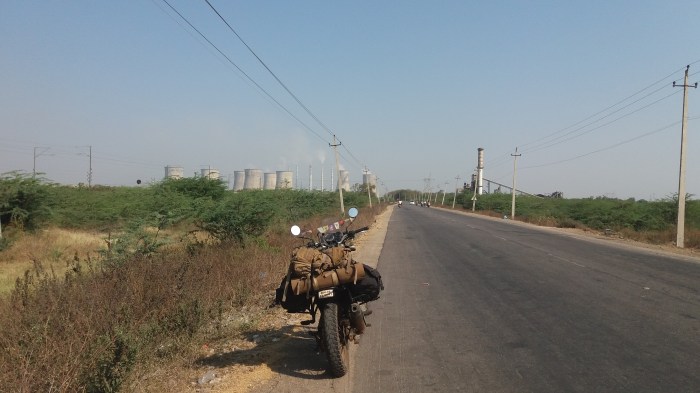
Beyond Hampi was a minimalist landscape with not much beauty save for a few broad acres of deciduous forests sprawling out from the rush of traffic. To the north and south of Telangana grew vast fields of cotton, and beyond this the coal mines of Chandrapur.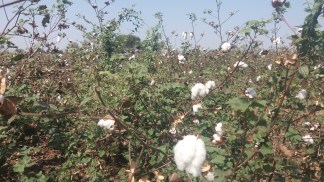 Tufts of the white fluffy plant matter drifted over the road as they flew from tarpaulined trucks reeling down the NH44 highway. I had never actually seen the cotton plant in its raw form before, let alone growing in a field, so at a petrol station I stopped and had a closer look. I could almost imagine the dark skinned indians wandering through the bushes collecting these snowy white puffs, destined to be turned into branded t shirts, towels, and bed sheets. Installed beside cotton fields were thermal power plants and massive hydro electric grids, that looked like something from a post apocalyptic movie.
 Hyderabad was a diversion into the gutter, it felt like no one seemed to care that I was there, and the hospitality was sour. Accommodation was spartan at best, and there was never a moment of real quiet, the city never slept and my own dreams were disturbed by the quickened nature of this metropolis.
 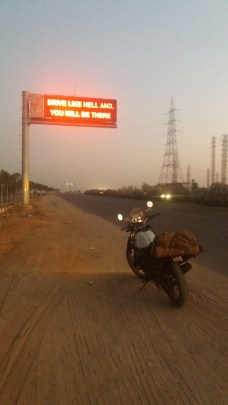 The novelty of moving through a big city in the early morning hours did have a unique effect on me as I escaped from Hyderabad before the sun aroused the mayhem of its denizens. Lighted boards, cold dirty air, cloverleaf flyover highways and miles and miles of concrete, and glass with activity at every corner. The first 270km was fast flowing on the Srinagar-Kanyakumari national highway but was nothing special. I saw signs for Delhi, Varanasi and Kashmir, far off cities I have never known. The freeway itself cut a huge tarred snake from the south to the north, and divided India into the west and the east. Stretching along the flatlands of Telangana the land developed a black suit of coal. The pavement turned to gravel, then dirt, then potholes and sand. My momentum was swiftly reduced like a free flying horse that suddenly had its legs broken, as I hobbled over dusty back roads that reminded me of West Texas. I covered over 400 km in record time, and now the roadrunner could rest while I readied myself for some time off.

 the motorcycle mantras