All great and important sagas must have an end. They must have a hero and a good deal of danger, romance, territory and emphasis on detail. I chose to be the narrator of this story because on a cool autumn day in eastern Canada when the maples turned red, and my motorcycle season was cut short by hallo’ween snows, I decided to finally venture out to India, and keepriding. This journey took me on a 10,000km road trip from Kerala to the Himalayas, where I met saint, sinner, guru and grandpa, old ladies with things on their head, monkeys with things in their cheeks, dirty children, and clean cut businessmen. I met some remarkable travelers on their way through the world too, and my last month in India seemed to magnetize all those most interesting voyagers into my sphere, as I changed my scenery, and charged myself up for a last ditch effort and getting out of the country.
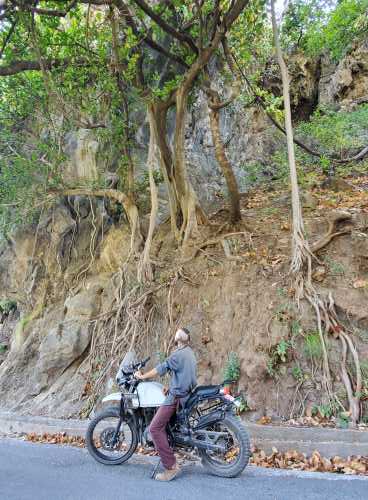
As the sweltering month of June brought 100% humidity and 48c heat to the Rishikesh, all the concrete Euclidean geometry of the city did nothing to lessen the sting of the climate, and just made living an even more intense struggle in the middle of a billion soul lockdown. I woke up one morning and simply had enough of my four walls and ceiling fan, of my modern bed and disintegrating surroundings. Even the culture of the hotel had become fragmented as several of my friends went back to their native lands. I was not about to become domesticized or lured by the seductions of a screen, wasting time indoors and eating malnutritive food to save money. A woman who I felt quite endeared to named Ruma told me of an organic village farm, in the Garwhali mountains just abreast of our Indian township. It was side pocketed away in the tribal village of Neer, in the county Daur, and were rearing up for the chia and rice growing season. The farmland was paddy grown on contour terraces that modified the mountain range into parceled quarter acres of flattened platforms where the bullock could tread, and small intensive plots of produce could grow. The farm was a two hour hike from the river through jungle and waterfall trails, just the kind of medicine I needed.
We would end up taking the gravel mountain road and trot down to the camp by foot for a day trip. With the woman on the back, and the wind in our faces we rose up above the city, taking the long way there. A 40km winding route that skirted the edge of an herbal park, and Narendra Nagar. The ineffable feeling of riding freely on a dirt bike into unknown territory, with a gorgeous woman sitting astride behind you, as the unfurling landscape presents you with head turning views is simply what the finer moments of life are about. With the engine at a low rumbling purr we passed through small colored villages, and I almost forgot what the real India looked like. I was reminded that life still carried on up here in the extensive rural countryside, and the hill tribes simply got on with it all. They lived their lives to the beat of a different drum. We parked the bike under a mango tree and started our descent into camp. Ruma and I met up with two of her friends, Giovanni from Switzerland, and Montserrat from Chile/Sweden. Before we knew it we were all hip deep in a shaded pool in the jungle, in our birthday suits, dragonflies buzzed around our bodies. They were volunteering at a homestay just neighbors to the chia farm, where another Indian man named Banu did sound healing with Tibetan bowls.
I met Anant then at the farm camp, and we talked about the village farming life, and when they expected to get under sway with the production. I was offered to stay and work in exchange for my own canvas tent and use of the kitchen. I said I would sleep on it, but I was fairly confident I would return in a couple nights loaded up with my saddlebags and ready for my new digs. In deed, it was less than a week and I opted to finally ditch the urban environment for the mountain camp, while we made a farewell feast for 30 in the hotel. It felt like everyone knew everyone at this point, and there was a good deal of hooking up going on, as people realized they did not want to bear the lockdown alone. It was fair game, and one I gambled on as well, but in the end I forfeited the compromises of attention to the female and went back to the roots. I would embrace the feminine in other ways while on the farm, through the care of plants, and the nurturing of the polar side of myself. I needed to slow down the motor, cool down the soul, and get in touch with the land again. Two months in the city was a subtle trauma that I would need to purge, and I know had just one of those power places to recharge.
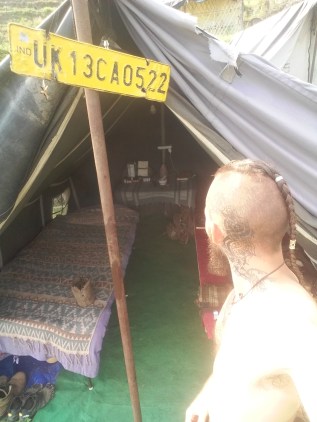 Over the next fortnight, I tended to my own routines and rituals and initiated several farm projects in the camp. It was entitled Uddibaba, which meant flying father, and surrounded some local folklore about a Baba that lived in a rocky cave that was on the property. I once scampered into the cave and scaled down into to the belly of it, where I found a bat cave, forty feet below. Blue bellied lizards, and palm size spiders made their homes here too. By dusk, the phosphorescent glow beetles made light shows all the way down the valley, while a colony of frogs that lives in the irrigation culverts charmed the sleeping mind. The mosquito pressure was light enough to sleep with the flaps of my tent open to the night, and I was not bothered by any wildlife larger than a mouse, who had a keen bravery for eating seeds and dates that I mistakenly left out. There were leopards in the hills that ever so rarely took a cow, but I never caught wind of their presence. Only the forlorn barking of a lone deer signaled for anything mobile that was larger than me on this landscape.
Anant had put up several of his Indian friends from around the state, and a few from New Delhi that happened to be stranded during the lockdown as well. They were all young, and I was taken off guard to find that I was the elder, at the ripe age of 29, though I would cross my third decade in a few months. Muni and Muki were brothers, and lived in one of the village houses up the hill, while Abinav lived in Rishikesh and helped on the farm in the pre-monsoon. Uncle Ji was the father, who eventually became a great mentor to me, as the farm work intensified. We planted five types of beans, some cucumbers, pumpkins, peas, beans gourds and red corn. The corn and beans planting especially connected me to home, and I thought about the summer pow-wows that would tour through the reservation lands, and the dances that would happen while the sun shined.


I wanted to return even harder after I thought about it more. I wanted to see Tyendinaga and dance with the Mohawk again, but I knew that possibility would be slim, as the world adopted a cancel culture that all but eliminated the possibility of organic society to flourish. To me, the social distancing and cancellation of events was far worse than any disease in the ecology. It essentially blocked the evolution of people, and put us in dire straights on how to continue as social animals. Protests, festivals, concerts, motorcycle rallies, evenings at the pub, library book clubs, meetups and dating culture didn’t stand a chance, due to heavy restrictions on public assemblage, this scared me. The world was going online and become further disconnected from our marriage with nature and our ties with our community. All our hard work at creating some kind of worthwhile culture out of the modern world was migrating to the backburner, and may just be burned up entirely.
Just before leaving the city, I had met one particularly fascinating young woman named Hannah, from London. She was on a bicycle journey from Vietnam to England, and had eventually wound up stranded here with us all in Rishikesh. She had already cycle through the seven sisters states, and was hit by a driver in north-eastern India. She was invited for a Ted Talk, and had grown a large following through her website, and blog, meanwhile rallying up charity services through donations. She introduced herself as a vegan, solo-female activist and feminist, and I wasn’t about to talk her out of any of her identities, but to me it seemed like a lot to hold up and a touch restrictive. She was highly sensitive and extremely brilliant, with a burgeoning light in her eyes and a good strong body. She impressed me, and that was a good start to our friendship. We actually met at a fruit stall, when I thought she was someone else from Canada. People were harder to recognize with masks on, and when she took down hers to say hello, I realized it was not the woman I had assumed it was. Nevertheless our friendship quickened over story, and she had promised to come visit me in the mountains on her bike.
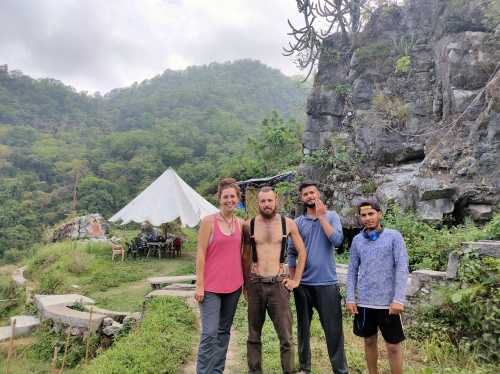
Eventually she did visit, along with other friends from the hotel, including Jean Francois from Quebec, to stay a couple nights in the camp. Hannah was full of curiosity and wonderment for this kind of lifestyle and she craved to learn more about the farming ways of yore. We fed off each others energy and never went hungry and took a small trek to the Neer waterfall where she made some photography for her story. I was privileged that somehow I was inclusive in this, and tried to remain humble. Of course, she was not a celebrity, but there is an accompaniment of awe when you mingle with people who are accomplishing great things, and it all went handsomely well between us. She eventually returned to the camp with ten other individuals who were keen to get out of the concrete clutches and into the wild again. There wasn’t a single one of them I didn’t like, and I learned a fair deal from each of them. The family was coming to me, and it was a good balm for some loneliness I had been feeling after three weeks without many visitors.
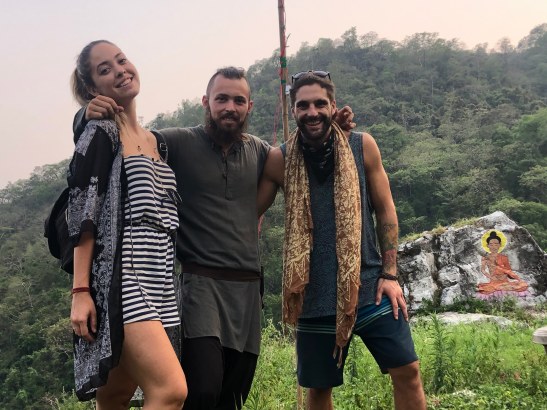
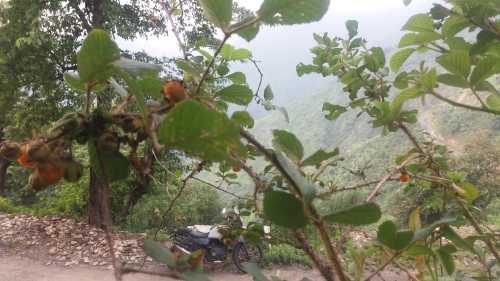
One day, Anant made the suggestion we visit another tribal village called Kasmoli, around forty minutes west of here to see a pair of bullocks. He had been the entrepreneur of the farm and the ‘Super Farmers’ company, and he stuck to older world ethics and pioneering technology like the yoke and plough, and hand forged, carved wooden tools for working the land. It sounded like a good idea, and we were joined by Uncle Ji and his wife on two bikes for a good rip through the ridgelines of the Garwhal range. Two kilometers from the village, we met Uncle Ji’s brother, and he engaged them in conversation. Eventually I was told that I could not enter the village or they would have to quarantine for two weeks. I swallowed the news but it was alright and I couldn’t complain for the natural beauty that was around me. I parked the roadrunner on the wayside and surveyed the misty mountains, dark army green and brushy. Nearby I spotted a few bright orange pecks of color, which turned out to be golden raspberries. I quickly filled my copper flask with these ripe treats and before I knew it, Anant was back from the farm and had approved of the bulls. They would come home in a truck, and we would motor back at our own pace, Uncle Ji and his wife would come later. We grabbed two beers on the way home and some sprouted chick peas snack that was marinated in onion juice and lime. They were budweisers, which I thought lowly of but these were not ordinary American throwbacks, they were tall 8% magnums and actually drank pretty good. We just needed some Western country in the background and I could have almost believe we were back across the pond, almost.
With the bulls came new lessons, as Uncli Ji taught me the ways of the plough and the yoke, how to steer these muscled up beasts of testosterone across a narrow terrace, and everything just felt right at that moment. The far faring view of the mountains, the thick forest greenery and camp tenting, and the sweat on my brow. I knew I was earning my salt, and it made it easier to stay in India. The bike was dormant but I was still active, and moving across the land, instead of horsepower I harnessed cow power. With most of the world on hiatus, I figured I was doing ok.
The final pieces of the puzzle would finally come into place one afternoon when I met Nicole from Coquitlam, B.C. She had heard of the camp, and came here with her boyfriend Pratesh, along with friends of mine, Isabel and Banjara. She was also trying to get home to the west coast, and had nearly as many failed reconnaissance missions as I did. For nine months she lived in India, working in a school, and Uttarakhand was her home base. The other three months of the year she lived north of Vancouver at home, and hustled her cash for the other nine months on the cheap. She had found a way to book a repatriation flight with Lufthansa, a German airline, and had found the tip off from a friend. We perused some of the news articles on the internet and found it to be true. Lufthansa would fly in empty, and rescue stranded foreigners from India, and take them on to Munich or Frankfurt, where an international flight to North America could be connected with. I was skeptical, and wary of these deals, as having attempted a week before to book with Air India on a mission, where single one way seats were posted at nearly 5 lakhs (almost 10 grand in Canadian funds). It was robbery, and no one I knew left in India had that kind of expendable money, but with all help from the Canadian government having petered out, it was the only option remaining. I let the opportunity fly because I could not justify it, and would not be able to re-coop from such a hit, but when I heard about the German flights, my bell went off again, and I thought there just might be something for the taking.
Wasting no time, I streamlined a connection to the Lufthansa airlines during a pause in my work. There were banking card problems, and then a fare change which actually hike the price to be nearly double by the time I was ready to pay for a seat, but a wave of ecstasy came over me when I received a ticket, and it felt like this would be the last time I would need to shell out. The schedule lined up with the dates that had been posted for these special flights to operate out of New Delhi, so it seemed that I would visit Delhi after all. That left the problem of returning the bike to Bombay.
Actually it was no problem at all because earlier in the lockdown I had rode into the downtown core of Rishikesh to the Royal Enfield showroom. There I met Ranjeet, who offered to parcel and shift my bike if I did happen to leave from Delhi instead of Bombay, and I kept it in the back of my mind for the occasion. There was one other company that worked across India, but their charge were far too much for my pockets and I thought it appropriate to finish with Enfield as I had also started with them. He also promised to get it there in a timely fashion on courier even despite the lockdown, and would deliver it right to the Rebel Rides garage. It was a stroke or two of good luck, and I only had a couple days to act. On my last day in India I rode back into downtown Rishikesh and delivered the bike. I had to pay in cash, because the money was not for the business but for the courier. Foolishly, instead of riding the bike back into town to look for an ATM, I started walking, perhaps I was just ready to leave it behind and didn’t want to deal with the heavy traffic. Well just in Indian fashion, it took four times longer than I expected to do the deed. The ATM than Ranjeet pointed me towards was further than noted, and I ended up walking half an hour looking for it, until I caved in and hailed down a tuk-tuk. It had been since Gokarna that I last sat in the back of these little motor taxis. The first ATM was out of service, the next two were closed, I had my temperature read at another, which was also out of cash. Others were turned off or not opened yet at 11am. This mission was starting to feel futile, until at last the driver found a bank with one working machine, and air conditioning to boot. I hurried back to the tuk-tuk with a stack of rupees, and b-lined it back to the Enfield shop. The price to send the 411cc, 400 pound bike was a fair deal lower than the competition, so I didn’t mind parting with an extra 700 rupees for a mesh hat with the companies logo on it. A final gift from India, and a welcome shade from the sun, it looked good on me, and I was happy to leave the Himalayan in good hands.
One of the mechanics offered to take me back to Tapovan where I had a lunch date with a sweet little woman from Poland in an hour. I took my final ride on the Roadrunner riding pillion on the back of my own bike, and he nearly got in an accident. As we rode through the market, a young driver on a scooty pulled in front of us as a huddle of several other bystanders moved from the road, he slammed on the brakes and bumped into him. Fortunately they were not the back brakes which were a little weak at this point. I almost got off and walked, what a tragedy it would have been to be killed as a passenger after a successful 10,000km journey on some of the trickiest roads in Asia. I made reasons for him to slow down by being the backseat driver, then asked him to pull over at a flower stall. I picked out some fresh flowers for my date, and that was that. We arrived back to Laxman square in one piece, I thanked him and went my own way, free of all remaining responsibilities to this country.
I enjoyed a small feast with the darling from Poland, and we stayed at her guest house until midnight. She was also going home to Krakov, and our taxi to the New Delhi airport would leave at midnight from the Ram Jula bridge. Our driver arrived on time, and we packed into the vehicle and drove by night through Uttar Pradesh and into Delhi. I drank one last chai, though it was not as good as I had hoped, and I drifted in and out of sleep with the windows rolled down to the night air. Near the metropolis there was an oil truck on fire in the middle of the road and it halted our progress slightly but we did find a way around it. The scene looked like something from a movie.
At the airport I idled for a very long time until the terminal was opened, as perhaps a hundred armed soldiers and police officers dressed in army camouflage bearing automatic rifles guarded the entry gates. They were helpful enough and not so imposing to query. I was told I had to wait until health officials would arrive at 7pm for screening and stamping off of official forms I had to provide. Everything was in order and the only thing to do was wait. Everyone was wearing masks, several wore plastic shields in front of their faces, and some even with full blue hazmat suits. The whole environment felt clinical and cold, and it really turned me off from the travel bug. I was starkly reminded what the modern world was all about as I moved through the duty free shops on the way to my boarding gate. The poverty of India was certainly not present here, and people moved around like pawns on a chess board, standing on circles waiting in lines, while attendants sprayed their bags with chemical disinfectants. Passengers were told to put their luggage through uv-scans, and then we were all given the same protective suits to get on the plane, which made me sweat. We looked like we were going into Chernobyl, instead of boarding a luxury liner to cross the world.
I caught a few cat naps in various parts of the airport, and kissed the girl goodbye hoping to see her again somewhere in the world.
There were many Punjabi Canadians returning home, and the airports were fairly empty even through Europe. I was processed through Canadian customs swiftly and it was actually one of the easiest entries into Canada I have ever made. My baggage had made the trip too, including the saddlebags, and I was grateful to be walking out into the air of my own country, where my father waited in a Dodge Ram to pick me up. I would have to shelter in place for another fourteen days as per order by the government, but I did not mind at all. We drove seven hours into Northern Ontario, and picked up the obligatory Tim Hortons coffee on the way until finally arriving at the cabin, deep set in the woods, where I would call home for a little while.
And this is where I remain now, as I digest the last seven and a half months of my Indian adventure, and try to distill all the intimate meanings from this most unexpected turn of events in the world history and my own life story, which now looks towards staying home, and getting back to the roots. I will be working on a farm in Quebec, and moving onto my land in New Brunswick when the work’s all done this fall. For now I am happy to re-connect and stay put for the next few years. I feel integrally changed from the trip and my priorities have changed away from international travel to one more devoted to the domestic rituals, nesting and building up the culture of home that I want to inhabit. It is simply the ending of one saga and the beginning of another. Perhaps it will envelop another in the years to come, but ultimately I don’t know how it will look like, only that I am happy to find out and proud to be home.
In the meantime, while corona viruses, mosquitoes, and global warming are ipart of our new ecology and social distancing measures are enforced in all our once favorite places, I am learning to grow into an even more wild human, and become resilient to the threats on our survival as a species, while continuing to thrive in the great outdoors, and engage with culture in the ways that always sustained us from time immemorial, in small tightly knit bands of people, within the organic societies that they produce. It is here where we will take root and stand in the most extreme of conditions, that this brave new world has in store for us. These are hard times, but they are also the good old days!
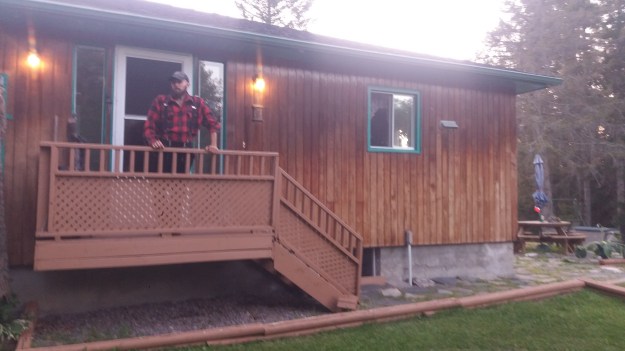
…it’s been a long seven year trip to get to my real Home, and I’m ready for something new, yet rooted in the ways of yore. For anyone looking to scout or follow the land based lifestyle I lead and keep reading my outputs, you can find me in here: aferalspirit.wordpress.com

 the motorcycle mantras
Well done!!!
I am so glad for you. You truly have had a big amazing journey.That you know who,what,and where you are going is an inspiration. please keep writing it is one of your many gifts.Glad you are back also, see you in Perth.
Love, light and blessings,
Marilyn
LikeLike
Your compliments are fuel in my tank. Miss you ’til I see you.
I keep writing at aferalspirit.wordpress.com
LikeLike