Probably a worse danger than the state of India’s roads are the drivers themselves. I have a prayer where I hail the road and the rider before every trip. Even a goat track with terrible topographical features can be navigated solo with the right gusto and skill on two wheels, but trying to get up to speed on the national freeways in the midst of monster trucks, and suicidal drivers is another heroic challenge to wrestle with. All of India’s trucks are branded in color schemes of the starkest primary paints that you might expect to find on an artists palette, flaking off variously where rust has attacked or where chassis length scratches from other vehicles have scraped off layers of their artistry. They bear hilarious slogans and sometimes puzzling commands on their bumpers and tailgates like “use dipper at night”, “wait for side”, and “Sound Horn, Ok, Please”. This one is my favorite, and big cities like Bombay to Pondicherry, from Cochin to Nagpur are in my experience a never ending chaotic symphony of horns. It feels incredibly aggravating having grown up in the west to use the horn so freely and incessantly; when approaching, when passing, when vying for space, when again in front, to warn animals and people crossing, sometimes to hear yourself be heard. It often feels aggressive until you realize how much more vulnerable you feel without a horn in a country of over a billion. It is so much a part of the driving culture, and just that fact alone says something about overpopulation and road etiquette.
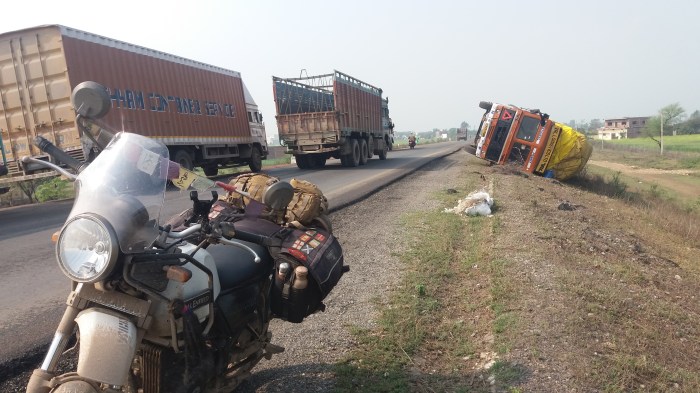
It was one of the burdened down camels of the motorway that put me off the road and rolled in the dirt. The Ashok Leyland diesel hummers from the Eicher truck company. Their strain under their tremendous loads, and I have seen them carry three times their size in cargo, pile nearly three stories above the asphalt. To get beside one of the great walls makes one feel small, and ant-like. It takes great courage to pass one of these behemoths, and I have become quite confident in my willingness to try. In my longer twelve hour journeys I will overcome thousands of these trucks, and have breached a few close calls as I weave through caravans of these wales of the road in order to get ahead of the fray. I have seen a couple of them on their sides with full loads still tacked and roped to its full iron hull, and many in various states of devastation, one of them even gutted completely from a fire it had succumbed to. It puzzles me why the Indians have gods of the monsoon thunders, elephant headed humans and an outlaw yogi but none that give blessings on the road, surely they could room for a motorcycle god in a pantheon of thousands of other deities. In the small villages between the larger metropolis, the young and old huddle and cavort on the street edges to inspect this phenomena passing through their home. A fully suited leather clad, bearded and long hair barbarian on a large iron horse roaring past their quiet kitchens and quaint countryside must look awfully strange to their eyes, several who have never seen the white man before, let alone riding an Enduro bike to the four cardinal directions of India. To these people who may have no conceptualization of the nearest city and who have not even left their own state, they stare on in astonishment wonder, maybe expecting me to do something miraculous, maybe it is already a miracle. Children wave, men flip their hands in gestures as if to say ‘what are you doing here, punk?’, others just stand with mouths agape, unsure of what to make of the spectacle, sometimes I wonder if when I leave there will be stories about the motorcycle God that once moved in their midst on an ordinary spring afternoon.
Relying heavily on gps coordination does not always ensure the route will be as it is advertised, and India is a country where this discrepancy with the local on the ground condition and the recommendations of complex satellite algorithms do just not always cohere. This happened in the most bewildering ways en route to Khajuraho via the great length of country passage through the state of Madya Pradesh. I started off early enough and sneaked out of Pachmarhi to share the night with the invisible animals of the dry savannah jungle, a mist picked up near dawn and my hands felt the stiff arthritic tension I experience from time to time in temperature fluctuations of cold weather. The coolness of the pre-sunrise hours was accentuated by the wind chill that refrigerated me through the porous mesh of my riding jacket. These early morning times drift pass without much thought or distraction, and indeed some of my finest hours in the saddle have been in the dawn hour. Watching the light permeate the land, seeing the villages come alive as I mend them together with the journey of the motorcycle, almost as if they were literally connected by an umbilical cord. People brush their teeth at the sides, men sit for morning chai, think and talk about the day ahead and joke about the day before, women carry bundles into the fields, dogs stretch their legs, and children wait for the school bus in gangs. Life resumes for another day, and it will be like most others.
The main difference between what happens at the side of the road and in the middle of it, is that I am astride a moving machine at 40-60km/hr, while those spectators have an entire life of experience right where they stand, where we lock eyes and for an instantaneous moment have shared a life experience together, both contributing to our own personal sagas. Sometimes these encounters can be quite intimate when I am literally brushing shoulders with the village people and paddling through traffic and tight alleyways of quaint townsteads seemingly existing on their own and for their own purposes. Sometimes there is no interaction at all, on the bypass with its concreted walls that shield out the city sprawl from entering, and thus create a separation of life from travel. Fast roads like this get me to where I am going a lot more efficiently, but the amount that is missed is staggering, and I actually prefer the shorter distance travel through small hamlets, medium size towns and farming communities. It is here I can make real contact with their inhabitants, where I can make eye contact and give silent gesture as if to say, “hey, you’re there, I’m here, far out”. It was on this stretch of fairly open road that I became more than a spectator and suddenly became part of the whole scene in quite an awkward way.
Originally I had bought an atlas from Eicher trucking company but realizing that would be futile and would get me lost, I resorted to the electronic map. Of course the almighty google does not always have our best interest in mind and after a few gorgeous hours of life on the bike, the ground beneath me promptly turned to dirt, then it narrowed extremely and developed a topography molded by cows and goat hooves, it grew brushy shoulders and sunk down with holes filled with pebbles, and in other places undulated with small sand dunes. The dirt became wet and turned to slippery muck and bottle necked further into a single walking path heading directly into an agricultural area. Ok, I had driven on several blazed and packed walking routes in Auroville and the hills of Munnar, I’ll just tread lightly through this and have my space given back in no time. This was not the truth this time as the muddy trail became hardly more than a ridge of wet slippery turf barely six inches across on which one could have trouble pushing a wheelbarrow even with both feet on the ground. This obviously mislabeled “road” that I had put my faith in tapered narrowly and led snakelike through a farmers field of Chapatti wheat, with absolutely no where to turn around. The earth beneath my tires was like wet potters clay that sloped down a foot on both sides into a flooded patty, high with the grasses of cereal county that stretched for hundreds of acres. I had come to far to go back and that was out of the question. The ground would be worse in the paddy and my bike would probably get stuck in the quagmire, not to mention the damage it would ruin on this farmers crops. I did not want to take that option, so I tried to balance the bike, reaching my feet down now on one side then the other, for they could not be planted on firm ground at the same time. In this ridiculous rocking action of the bike and some fancy but complicated coordination with the clutch and throttle I was able to move about ten meters a minute. Then there was erosion and I had to get off the bike, and push the entire 400 pounds of steel and iron along with 30kg of my own travel wears and gear through this marsh and somehow keep it upright while I could get no traction underfoot. I passed another few feet and several more of these challenges faced me.
Ironically, another bike pulled up behind carrying a passenger and I thought it a hilarious situation, I was stuck on this farm on a tightrope trail and now someone wanted to pass. He made it look easy on his two stroke engine even with the extra body. The tires were losing grip, and the path itself was no longer even level, and now some poles jutted up from the ground, while the girth of the poles and the vertical intrusion of their placement made passing by with the motorcycle even more trying. I had to lean the bike over in the opposite direction of the poles at a 60 degree angle, while standing nearly in water and somehow strain to hold its enormous weight and keep it from tumbling sideways into the flooded wheat field. This worked for awhile and then I could manage to straddle the bike again and push the poles over to allow for the handles to get pass which took a lot of my attention off my front tyres, and I ended up more than once downing the front end of the bike and dropping it a couple times, at least it was a soft landing, but it took an enormous herculean effort to get it right sided again since the bike was not on a plane surface.
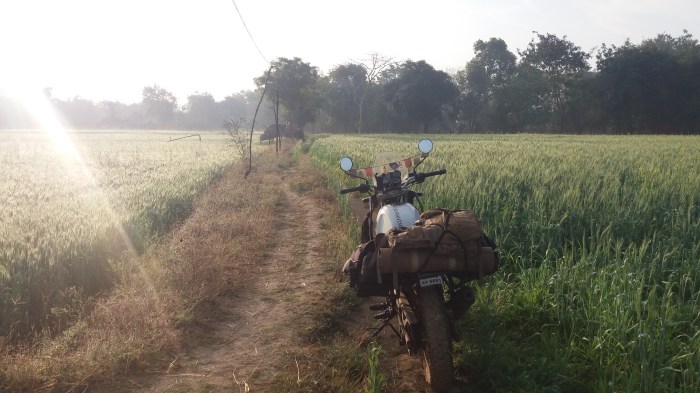
Eventually after over a thousand meters of this I had attracted a lot of attention, and four men were walking alongside me giving advices in Hindi I could not understand but doing nothing to physically help. I think they were quite amused to see me and I wondered if they too had not seen a foreigner as I was pretty far off the beaten path, literally. Their grimaces turned to laughter, then utter confusion, and concern as I struggled to steer my behemoth through the bumpy field and not make a fool of myself. I signaled with my arms to ask if it would lead to dirt again and highway. Some of them pointed off in a vague direction, that looked to me like going straight into the middle of the crops, then they corrected themselves and made motions that signaled me forwards towards where I believe their was a village. Sure enough I made it through this predicament, down into a river bed, forded a stream and up the other side into a tangle of huts. The conditions became better in reverse order of how I had found them with the village roads fairly navigable by bike at least. If a messenger had not run ahead to bring news of the spectacle I would have been more surprised at the turnout. It seemed that entire families and maybe half the population of this little place were lining the roads, most of them as stupefied. More hand waving and gestures of dismissal, and I puttered to an idle at a cross ways, asking some old men that were carrying on a conversation in the middle of the intersection which direction led to the freeway. A young guy on a scooter with a girl on the bike rode up, whom they obviously knew and spit a few commands at him to “escort this crazy foreigner out of here”, at least that is what I thought they could have said. I hit dry gravel, then asphalt, only then could I really appreciate the fields now that I rode beside them and not in them. In a couple months that would be dried, hulled, ground, whetted and rolled into chapattis.
Grateful to be on the open road I picked up my tail and took the roadrunner into a precarious state of speed to compensate for my slow farm tour. The freeway linked up with the 44 again and the road Gods picked me up and carried me in their arms with some interesting scenery, old palaces and bridges.


It was good sailing until I could feel a slight shaking and wobbling coming from my horse. I knew she wasn’t the youngest steed to trot, but this earth was flat and there was no reason I could conceive why my tyres would sway to and fro at mid speed. I pulled to the side and gave it a once over. The front forks seemed out of line, but the wheel ran straight, and the bent fender gave the illusion that I was running crooked. Chain was taught, and everything was buckled down and balanced, so I took the reins again and joined the parade. A few miles on and the snakey slither took me off guard again and carried me off my line, so I coasted up to the shade of a tree where three men chatted next to their Bajaj and Hero bikes. They could see what I was up against as they sat the flat in my back tyre, which I couldn’t detect when I was off the bike. Well it turns out I was only a couple hundred meters from a branch off the highway, and there was someone there who could fix me. I trailed the guys riding tandem on their Indian streetbike while I followed with my oversized dirt bike all loaded with two seasons worth of gear and loot. The journey halted with still three hundred km on the clock. It took two of us to hoist up my ride onto the center stand, and he went right to work. The mechanic also had a small calf under a tin shed with carefully proportioned doses of feed sitting outside its crate. In no time he had the tube out of the rubber without taking it off completely, another man made a patch and heated up a propane burner to make it pliable as he cooked it like a fried egg and brought it over with tongs to mend a hole in the tube. In India, the country roads are often a carpet of various debris that will put holes in your wheels or your feet; glass, nails, plastic shards, thorns of spiky plants, and bits of scrap metal in places they shouldn’t be. I have seen woman in high-vis sars on the big highways and the city streets sweeping with homemade brooms, but I had seen some sketchy places with the bike, and probably picked something up. I had no idea what something like this would cost in India, so I handed him a 500 rupee note ($10), hoping not to offend and prepared to give a little more. He handed back 440 rupees and said sixty ($1) so I tried to offer a tip and eventually he took 40 rupees more. Bike repair was so cheap compared to Canada.
By dark at last Khajuraho was within reach, and when I finally turned off my motorcycle, the time was 8:35. I had driver 15 hours all in, and made a few gambles along the way, but I was happy to reach a bed at the moustache hostel out of the busiest part of this very old town. The guys made me a deluxe thali, and I stowed away my saddlebags, ready to put down for a few nights.
Khajuraho was an intense place, and there were lots of hustlers and shopkeepers who wanted something from you. I couldn’t walk 100 meters without being offered cannabis and hash, or being ushered into a mart that seemed to offer more of he same assortment of things as any other; books on the kama sutra, expensive shawls, carved marble pieces, brass locks and statues, jewelry. Not that some of it wasn’t nice to look at it, the craftsmanship was impeccable, but if you have been in one Indian bazaar you have seen them all. Of course different places in India had their specialties, like the gem dealers in Pushkar, the Pashmina clothiers in Kashmir, and the chocolate and coffee peddlers in the Kerala hill districts and maybe my opinion would change on that, but I did not really come here to shop.
Instead I preferred to take in the little things that seemed to be totally ordinary in Indian life and things I may not see in my own country. Patties of cow dung dried on the street, and I watched a man tap handfuls of ash into his clay pots while they were hardening in the sun, a white rabbit hopped about between pyramids of vegetables in a vegetable market, men hammered down on hot iron beneath tarp tents to forge farm tools, while their women kept the forge coals burning with small wheezebags, a bristly boar with a sunburn ran in front of me to munch on some food at the curb, a gypsy woman washed her children with buckets of warm water in a shanty, and men poured gallons of milk into steel cylinders to be delivered around town. I got a shave from one of the barbers who after working wonders with his straight razor on my Viking beard, gave an amazing head massage and nearly a full body treatment right there in the chair. It was these mundane insignificant part of travel that I learned to be more grateful for.
Some of the temples were free, while the main ‘Western Group’ was a 650 rupee charge levied for foreigners only. The local Indian charge was 40 rupees, and I couldn’t grock the massive inflation, and this crookedness of the government to set such a high rate for westerners. These temples were over a thousand years old and had celebrated archaic rites of love and sex before India was even an economical power, so the whole thing confused me intensely. At night the temples were lit with neon and speakerboxed with modern pop music. The more I visited these holy places, the more I actually left with feelings of disappointment. The sheisters at the gates, the high fees of observing ancestral creation, the tax deductible blessing rates, the queues of people lined to worship statues, and the hordes of tourists snapping selfies entirely missing the moment. My overall impression was that Indian spiritually was rather weak, and I felt more at home with the connections I had made with the Nordic faith, worshipping outside, and the freedom of expressions it provided for a heathen hearted man like me.
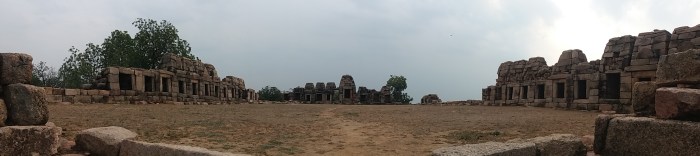
That being said I did visit some of the free temples, and stole some intimate views of the grander sculpted towers from outside the high barbed wire gates and fences and actually felt better standing there than inside, where I had my own space and could see them in their entirety. What I saw was unique and extravagant with depictions of passion that any man or woman lustily dreams of in his most hedonistic fantasies. Kama was an important part of a man’s life, and was equally as needed as his life’s work and spiritual responsibilities. It was here that India’s temples were uncensored and showed the older, rawer way in which love was celebrated. Thousands of characters in gestures and motions of sexual frenzy and arranged in a hundredfold positions of sexual enjoyment. There were large breasted women with gangs of men, princely looking man with flocks of sumptuous women, penetration of all sorts, 69, upside down and turned around. Ox headed creatures, horses and dogs, and elaborate scenes of courtship like romantic sagas etched into stone forever. I was actually surprised there had not existed any underground red light district here given its history, and the Indian seemed to appreciate the images of orgy and sexual hedonism as much as anyone else. We didn’t really have something like this in the north, besides some yoni stones and small cut rocks of Nordic babes in old Viking settlements. I thoroughly enjoyed that places like this existed to see, though sadly a lot of them were broken and missing faces with private parts chipped off. It was the British in-sensitivities when they occupied India, and the conflicts between the Muslims and Indians that spelt the ruin of many of their famous temples.
Once you have seen the temples you have to be creative with your time, so I used some of this free time to finally send some parcels to my neighbors in a small New Brunswick village, and write a couple postcards at the Madras coffee house. I filled a few small boxes of sweets and collected a couple gifts together, then searched around for a post office to whisk them away to Canada. The process was a lot more complicated and expensive than I could imagine. First I needed to find a tailor with good quality cotton to fix me three pouches for the parcels to be packed inside. I sat for an hour drinking good ginger chai with the sewing man while he used his machine to them as compact as possible then hand stitched the mouths, wrapped and ready for shipping. The local post office said it was not possible to carry out hte request today because the system was down, so the tailor took me on the back of his bike to Rajnagiri 15 minutes away to where there was apparently another office. I stood in a line for thirty minutes while various other matters were attended to. Then came my turn, phone calls were made to ask about international sending. Return addresses were necessary, even for foreigners. Id scans were needed, and three matching forms requiring four signatures each, online registry in which all of this information was copied. Then a sticker stating the contents and values. I scribbled in “spices, shirt and postcard, and 500 rupees” thinking this would be close enough. Then I had to pay for the tape to secure all the documents, so another man was called from the village who had the tape. Another 20 rupees. The packages were weighed, then passed around while each boy in the shop look inquisitively at the names and the country, reading them off in vain but amusing attempts at the English language. In the end and nearly 4000 rupees later they were grouped with the other pile and ready for the plane.
I idled pretty heavily in Khajuraho and was invited for a village dinner by a young guy named Ifrahan, who showed me his farm in the countryside. We picked some of the local ber fruit from a tree and ate home made chapatis from the wheat growing in his field. I visited his family, and he showed exceeding hospitality and I learned that he was a student, with a pretty good education. He never asked for money and his teeth were not rotten from the constant chewing of pan and betel nut like the majority of the poorer men in Northern Indian I have met. I came to trust him as we lazily putted around in a tuk-tuk, and went on our own tours our own way.


I met another biker riding an Avenger, a kind of chopper that had the long drawn out style and higher bars of a Harley. He shared with me his dream of opening a guesthouse where foreigners could stay for free and immerse themselves in the local culture, travelers down on their luck looking for a respite. This dream sat on the backburner next to another of opening a motorcycle garage, but he was good company. I met a man from an artist caste producing some of the finest work on canvass, and velvet I had seen in this country, and a turbaned fellow in the bazaar with his white camel. In the afternoons I visited the yogini temple for a yoga seance where I was left alone, and walked around Shivsagar lake and past the mela grounds a couple times late at night. A massive fair was taking place, and seemed to kicked off when the sun went down, some good old fashioned carnival vibes complete with ferris wheel and street food, but it was not really my scene.
I couldn’t take the heavy hustling and noise of Khajuraho, and readied my things for the pilgrimage to Varanasi, one of the ‘holiest’ places of India. The moustache hostel had been a pretty fine place to lay my head, but I felt the old pull of restlessness and thought about escaping in the night before the world woke to see me do it. I was hungry for something more, I craved a different type of India to impress upon me. I was starting to feel a little jaded and unhappy, and sometime ornery with my emotions, and I knew that was not like me, or at least not a significant part. It was about now in the trip that I would have welcomed a companion rider with open arms. Two was sometimes better than one, and it could spice things up. I was just over halfway done and still had a lot of steam left for the north.
There was not much to see between Khajuraho and Varanasi, and I had no road problems this time. The sprawl of urban life become more concentrated, the air a little thicker, and the Ganges river closer with ever turn of the tire as I closed in on Uttar Pradesh. I had waited a decade to finally see its banks, and a new excitement built in my spirit to reach it. Varanasi was a city of saints, sadhus, thieves, beggars, seekers, sellers, the sick and dead. Indians traveled from all over the country to be burned there on the ghats of Manikarnaka and Harachandra.
When I finally rolled into Varanasi, the immensity of where I had just brought myself to had taken me off guard. It took my half an hour to move just five hundred meters. Beady eyed men grabbed at the handlebars of my bike, while I brushed past woman holding babies, dogs, and water bulls on a broken road strewn with boulder size plates of concrete and massive gangs of bodies crowding every conceivable niche of space to park a bike. I turned down an extremely narrow alleyway about as wide as two cows standing abreast, and somehow managed to crawl through the claustrophobic passages to find a guesthouse about 1 km deep into these labrynthine paths. They ran with rats and various sorts of waste that was swept off to the sides, and the motorbike travel was constant here too, which made passing in the confined spaces quite an affair. Some policemen waited on fourway crossings shouldering high powered rifles and pistols, and seemed a great deal more stern than those in the south. It took me awhile to find a safe place for the bike but I settled for one of the emptier allies I could find.
I checked in and went down to the ghats as night cloaked the world, and meditated awhile on the journey so far; how I had come here, and where I was going, was it all worth it, and how would it affect my homelife, then all those thoughts went away as I dissolved into the moment. Here I was in a dangerous and chaotic city in Indus land as old as time, halfway across the world on a motorcycle trip, walking on the ghats of the Ganga river, the stuff of legend and myth, now I was part of all that, and I carried that thought with me all night.

 the motorcycle mantras