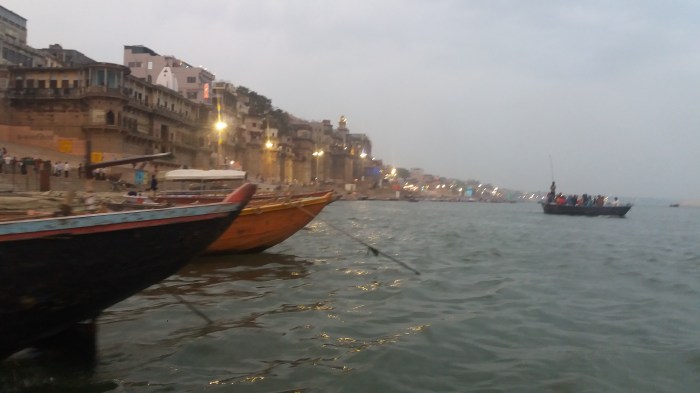
Varanasi was the first time I saw a dead body in plain sight. Along the banks of the Manikarnaka and Haraschandra ghats are the burning pyres that are steadily lit day and night, and have been for thousands of years. Here in Hindu faith is the holiest place to die, the bodies are carried down to the shores on a stretcher made of bamboo poles lashed together with ropes. The finest silk cloths in yellow, orange and pink are draped over the body and wrapped, having been first thoroughly massaged by the family members and oiled with various essentials of plants like sandalwood. The shroud is brought down to the edge of Mother Ganga where it is sprinkled with water five times and walked around an equal measure. Special prayers are said and flames of candles are swirled over the relative before it is hoisted by four sturdy men (and only men perform the funerary rites), onto a pyre of chunky firewood pile so as to accept the corpse in a cradling fashion. The white cloths occulting the face are removed, and some colored pigments are touched onto the skin, and several of the energy points of the body. More wood is piled on top of the rigor mortised body from the ankles to the neck, with a space neath the body for the insertion of grass bundles lit as fire brands to ignite the pyre from the bottom up. Small sticks of sandalwood are placed delicately over the body by various family members. The once active and thriving being is then incinerated in plain sight for three hours until the skin is blackened and the bones are brittle. Members of a lower caste who work with the bodies use long bamboo poles to nudge and prod the parts of the body further into the flames, then the skull is crushed after two hours to finally release the spirit from the body and rid the soul from being reincarnated in the cycle of birth and death.
There are strict rules about who performs the rites, and who is allowed in attendance, women are forbidden to witness the burning even if they are relative or husband though some exceptions are made, for it is said they can not easily control their emotions and the highly ritualist nature of the cremation must be properly done without disturbance. Priests of the Brahmin order are the only people permitted to perform the death pujas. They shave their heads save for a small spot of hair at their bindu directly at the back of the skull. This is where is believed the spirit enters at birth and exists at death, and is the link to godhead. They wear only white robes, and often do not speak and I have noticed are often very old and frail. After the body is burnt there are some bones that do not completely disintegrate in the fire, the chest plate of men and the hips of women, which are taken and thrown into the Ganges. At the Manikarnaka ghat several tiers were reserved for different castes, with doles, dalits, thakur (lower caste) closer to the river, with Kshatriyas higher up, then Brahmins inside a four story tower. During the monsoon rains of summer, the entire ghats and stairways go underwater and only the levels of the tower can be used. Another southern ghat is reserved for people that have died by murder, suicide, accident, and they have an electric cremation. There are some people that are not burned on the ghats as of custom; pregnant women, children, lepers, cobra bitten, sadhus (holy men), and animals. These are instead sunk into the river with stones, though I never witnessed this myself. The above visceral details are from my own first hand experience and quiet observation along with bits of information I gather from men hanging around the ghats.
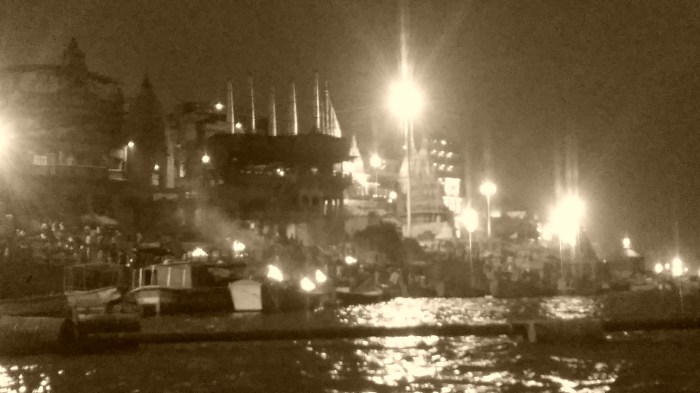
To sit in front of a blazing fire feeding on with what was a living breathing human being is one of life’s experiences that quiet the mind and distractions and bring one into direct contact with death in a meditative state. Despite the grim scene, I found myself not torn by shock or awe, but simply arrested by the purity and naturalness of it all. I knew Varanasi was a place where death and live were embraced, and had mentally prepared myself to bear presence to such scenes, but when the moment came after nonchalantly walking the shore of Ganga to find a fire, it was simply another moment of awareness. I first walked down to the pyre and stood before it until I realized what was happening, there was an air of reverence and tranquility, which were not moods that usually surrounded the fireplace in India. I saw the familiar figures of limbs and head, and was brought into a place of quiet inspection and introspection as another soul was released from its karma. The morbid scene with the spectral lights, char black colors, bright silk cloths, shadows shaking in the distance and the crowds of distorted features set against a backdrop of decaying palaces, ancient temples, hungry wild dogs and a holy river, it could have been a Hieronymus Bosch painting.
All of this happened at the end of a grueling road day in the pre-formentioned transmission, and I fell to sleep in a very interesting mood. The morning walk on the Ghats did not have nearly the same effect on me as when the candles were put out, literally, in silver paper plates holding aromatic flowers and camphor crystals, in the dusk hours and through the night. I did not dare take the bike out during the four days I stayed in Varanasi. The constricted alleyways filled with debris and swarms of people in the market streets would swallow me whole if I tried, so I contented myself to stay near the river, and see what would come to me during the course of the next 72 hours.
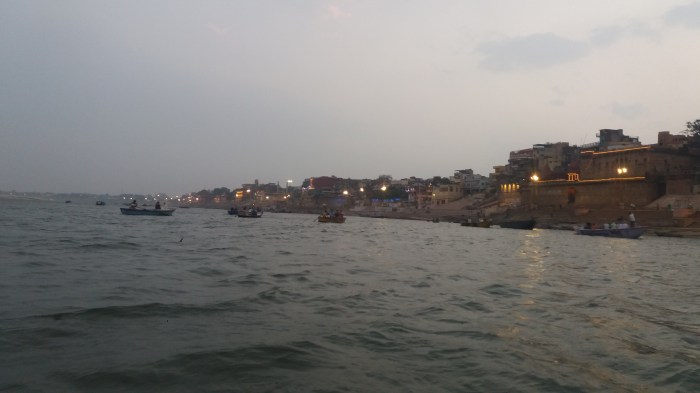
Walking the entire length of the ghats from bridge to bridge, I experience a heavy dose of raw Indian culture and its most beautiful and its darkest, where the life is probably more diverse than any other and easily the most intense place I have ever been. Hustlers were eager to take your money in various scams ranging from offerings of firewood costing hundreds of rupees per kilo, or good karma donations for hospices that never receive the money, a man sold rare kingfisher birds in two cages slung over his shoulder, and asked for 400 rupees to release each one in the name of good luck, children asked my name then asked for chocolate, watches or money, sadhus bathed in the loincloths in the filthy river, donned with the holy orange outfit and smeared with ashes, though there were many fakes, often posing for pictures then holding out their hands for money. Cripples and lepers also banged their begging tins on the ground to scrape enough rupee coins for survival. I saw yogis from the west, and babas working out on temple steps doing hundreds of hindu pushups. I watched ducks at the river feeding on algae, and mangy dogs looking for scraps. A movie was being filmed where two men fought with a sword while Sadhu ‘actors’ sat in meditation with dreadlocks piled on their heads. Horses ate from piles of hay, and monkeys caused mayhem on the scaffolding laid up against several hotels and heritage buildings. Wooden clinker boats were in various states of completion and the myth of the ferryman was real. I did yoga on the steps and generally kept to myself here. I was tricked into buying some of the cremation wood at enormously overpriced rates, which I found out later was not actually for the ‘poor families and underprivileged’ it was stated to be for, and this left me with a bitter taste of the capitalization on others peoples mortality for profit. It seemed that not only spirituality but death too was treated as a business opportunity in India.


Varanasi also had a disproportionate amount of Japanese and Korean tourists, something I chalked up to their religious nature as a place of spiritual importance. There were entire hotels with only Japanese and several of the menus I looked at had several pages of oriental food. The street markets sold every kind of fruit and vegetable, even mangos which are only now beginning to ripen in the central states.
In this city I truly felt anonymous, there was probably nothing I could do that could actually stand out in a place where it all happened before. Sadhus could sometimes be seen performing extreme acts of penance or fakiric arts like pulling wooden carts and lifting heavy loads with their penis, levitating or laying on beds of thorns. I was not so lucky to catch one of these Naga Babas in the act, but I did see one sleeping on the stairs, and it made for an iconic picture.
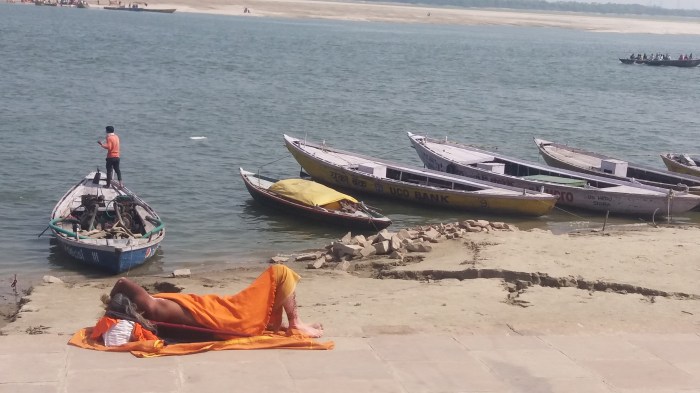 The rest of the time here I hid out on rooftops, and decided to leave the weekend before the Holi festival, while I crept out of the maze of Varanasi early on a saturday morning to my astonishment, in heavy traffic. My silencer conveniently dislodged itself from the muffler at the hour of 4 am, and in the tiny passageways leading from my hostel to the core of the city sounded like someone was pounding on double bass drums at a heavy metal concert. Ironically it may have been the most fitting way to leave this place of chaos. Varanasi was not a bad place though, just one of overwhelming sensation, I ate well and found my spots of refuge to read some of the literature I had packed while overlooking the city and the river. I made keen notice of how the life on the ghats altered from that in the alleyways. One night I even rowed down the Ganga in a rickety wooden boat to watch the aarti (spiritual prayer songs) which happen every night at sundown, and once again see the smashan from the waters. It could be heavily disorienting and extreme for those who have never traveled to India like myself, and I will probably continue to digest those four curious days and nights at its banks for the rest of my life.
The pull of the mountains took me north into Uttrakhand to the foothills of the Himalayas. I rode through the densely populated Muslim biased state of Lucknow, and passed some cool looking ruins of palaces rules by Kings I knew nothing about. On the way I gave my bike a wash to clean some of the caked mud off of the engine. It still gets dark around six so I slept one night in Shajahanpur, north of Lucknow by a couple large cities. The police presence was heavy and I thought that I may have made a bad choice of resting spots, perhaps there was a riot or an incident I was unaware of. When I finally found my lodging after scouting down a few long tunnelike alleys, my host said there was increased security for the Holi celebrations to protect conflicts and violence between the Muslim and Hindoo who did not always cater to the same opinions and public displays of ceremony as each other. I did not sleep however, mosquitoes were able to get into my room from an open barred window with no screen and I struggled to keep warm. I slept in ’til seven because I felt like an old man, and was not ready for the motorcycle. I would ride to Nainital and it was only five hours, so I procrastinated my departure, nursing tall glasses of masala chai and snacking on biscuits while I went through the rituals of packing my saddlebags, so far I had lost nothing on the journey and that gave me some pride, I may not have had the riders ambition today but at least my memory was as sharp as a straight razor.
The tripometer flipped over 8000km early on the route to Nainital as the temperature declined several degrees and I rose in elevation out of the plains. Dust storms on the road, and heavy lorry traffic made it impossible to cover any great distance very quickly, and I passed by what might have been India’s central sugarcane processing factory. Trucks were lined for several km packed to the brim with cane stalks, hundreds of these multi-axle road camels in line for delivery. It was a sight that could not be captured well from the ground level and I thought would lend better to aeriel view but alas I am not equipped with flying drones and am hardly less a photographer, but a storyteller. I thought more about death and this personal experience I was having, that maybe I should have some carefully written rituals written out and stashed in my helmet in case of the accidental passing from my own mortal coil. I had actually always thought about it since the beginning of the trip, but I also believed that the more energy I gave to thoughts of that vein, the more powerful the likelihood of such bleak realities coming true. So I released the idea again, as it became like smoke filtering out of lungs dissipating back into the ether, the air was clean again.
Rising into the heights of Nainital, I suffered another flat tire and was forced to ride on the rim until I found a mechanic, and luckily arrived to meet an eager young man who would work his magic on the bike. Inside the tire he found a small nail that had pierced the thick galvanize rubber and was slowly piercing its way deeper into the tube, thus I had issues of covering even a hundred km in this way and had to replace it completely. I went to the bank to make a withdrawal and when I returned the tyre was already fixed with a new rubber inner strip to boot, which the local barber had cut from my old tube. He jovially went between cutting hair and helping the mechanic fix the tire, which may have been his son, sometimes right in the middle of the shave job. He also corrected the position of my clutch and brake pedals so they wouldn’t rub against the clutch arm and the muffler, which prevented me from braking fully. They had bent on a fall I had taken awhile ago and I didn’t think to just pry them back into place with a crowbar, lest I had one, maybe I was just lazy.
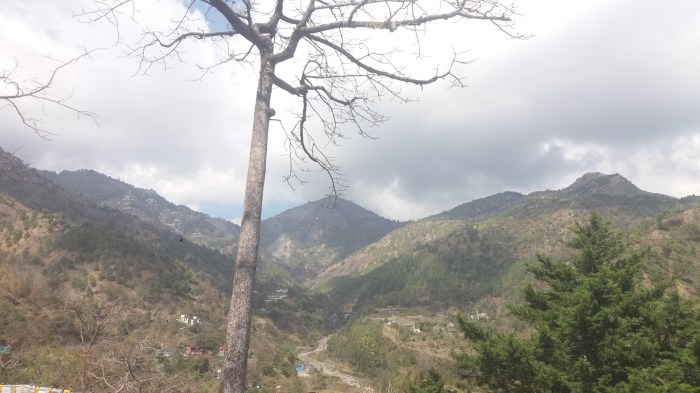
A famous baba named Neem Karoli once lived here and helped establish several Hanuman temples. It was mostly his influence and the string of stories associated with Ram Dass and his followers that brought me to Nainital in the first place. I had developed a working knowledge of the guru during this India adventure, and learned not to trust anyone who fully proved themselves, but I was not here to sit at anyone’s feet or sweep up an ashram to gain enlightenment. The land looked coincidentally a lot more Canadian, as spruce, pine and even oaks dominated the landscapes. Vendors sold honey by the roadsides, there were real indoor cafes, it was cold at night and the mountain springs meant I could drink the waters and not worry about any nasty infections. There were black panthers, bengal tigers and black bears that came out at night, and I hardly noticed any street dogs. Instead people kept them well groomed as pets. Ah, more like home I thought, I felt more in my element already.

 the motorcycle mantras