Up before the sun, I cook my porridge and stuff my military backpack with a few weekend warrior supplies, a change of clothes for high altitude, some compelling Indian literature, a cold flask and a hot thermos of turkish coffee, so I can sip the bitter brews while at an eagles eye view of the land. Next door to the hostel I meet with my riding partners, and we discuss an itinerary and backout plans in case we get separated. The compass will take us due north through a few hiving and jiving cities; Dehradun, Mussoorie, and Purola, all of which have police traffic control and barricades. It will be imperative to seek efficient passage en-route and mine for backroad entrances and exits for a smooth travel experience. Travel within the state is still permitted, but we were one day before a national curfew was declared by Modi, the prime minister of India. Come Sunday at 7am, wherever we stood is where we stationed for the next 24 hours.
The roadrunner was back to its old antics, and the brake pads were rusted over causing a metallic friction and scraping noise that spoiled the sensation of riding an otherwise solidly built motorcycle.The silencer was loose and wobbly too, and I didn’t have the right spanner to tighten it down. The early honeymoon months of the trip in Tamil Nadu, where the bike sat malabarred in the monsoon rains for over a month was now taking its toll on my long hauls and daily commutes. It ran like a King off road and no road, but the recurrent issue with the calipers had me grinding my teeth. I had a feeling this may be the last heroic journey for awhile as my trip-o-meter snuck up on 10,000km. Over the grating headache producing noise pollution of the bike, and the puff puff of the muffler, a new problem emerged. The cooler climate and higher altitude launches of my early morning take offs presented some start up issues with the battery, but this turned out to be easily worked through by riding with an open choke for the first few minutes, until the engine breathed its own fire without my help and I could depress the choke again. Rishikesh was still a hub of construction and the recent roadworks were not yet in tune with the navigation, so I was rerouted a few times when I found myself at gravelly dead ends overlooking sections of the bypass with free-flowing traffic and no perceivable way of getting there save for building my own road. A demoralizing feeling accompanies the rider in these situations. In eye shot of the road ahead, so close yet nowhere to go.
At Dehradun, a rolling steel gate barred the road with three or four traffic cops wearing masks and suited up in their brown uniforms waved people away like shooing flies. I idled down and shifted to neutral in front of one of the officers, just as one of the female patrol asked where I was headed. I answered in honesty, to a small hill station where I would take a rest stop but was signaled to turn back like the rest of them, “it’s the corona virus” she shouted, and the words bludgeoned me like the bamboo canes they carry close to their hips. But I had no intentions of remaining at Mussoorie, my resting place would be four hours at average speed further north, and I had every right to keep moving, at least for now. I studied the map for awhile, and found an alternate way through Dehradun which corralled me around the wall of the cities team cricket stadium, and dropped me into the core of downtown. A more convoluted and roundabout way but altogether for the best. As I hit a speedbump unexpectedly, the silencer completely dislodged from the motor, and my motor horse suddenly sounded like a small plane taking off. The buffeting of high decibel explosions coming now directing from the engine was deafening and certainly aroused some unique attention. I pushed the bike onto a mechanics tooling pad around the corner from the incident, and asked for a lag bolt to refasten the pipe. I had lost one on the way, and there was no chance of retrieving it, for all I know it could have dropped off three months ago, and it was only a matter of one bad vibration that would boot the other one off its threads too. One of them tightened the existing bolt, but put it on crooked, so I took the matter into my own hands. The old saying if you want something done right, you need to do it yourself. I cranked down on the single bolt while I held the pipe in place. There was minimal cooperation and my trust in their mechanical competence paled. They were relenting to even touch the wrench after I was done with it. Their attitude belayed the fear of the foreigner that had recently been instilled into the Indian people through the news sources and public announcements concerning the virus situation in central Europe. They saw white skin and went into defensive mode. It felt pretty alienating to be seen in this cast, and the human(e)ity was starting to sink away from the people. I left feeling pretty small, and still didn’t have a healthy bike to ride, so I peeled my eyes open for the next way station where I might take care of the issue. After a roundabout I found another fixer upper, and parked on the side of the road near a traffic booth. A gander of men watched in grimace as I rolled up to the garage. But ask and you may find, and before too much banter between us the right bolt was secured and cleaned off of grease. I payed the highwayman a twenty rupee note and went to work on the muffler. Two points of connection now held it on, and it was snug as a bug, so I let it be and put it out of my mind. They still couldn’t fix the back brake calipers and ushered me to a nearby Bajaj shop, but I doubted it would make any difference. I had no money for replacement parts and would rather loosen them off and brake harder than invest in new ones. I let the bike cool down then peddled off the curb like Fred Flintstone, crossed the oncoming lane and was back on track.
I cleared the final fringes of Dehradun without another incident, and rose up the camel’s back road for Mussoorie. We convened at the Kempty waterfall for something to eat, but everything was closed. No street food carts by the wayside, no local dhabas with cheap lunch fare, no roadhouses or coffee shops serving up Indian breakfast. We high tailed out of Mussoorie down into the next valley, and eventually did find a small kitchen joint that had a pot of chai on the burner and some spiced rice and alu parathas to offer us. This would do, and I quite liked the potato pancakes that were common in the north, so at least I wouldn’t be hungry for the next five hours.
My riding partner was no good at staying together, so our ride turned into a game of cat and mouse, chasing each other, then falling back. We bargained some time at Lahkaman Dhala to visit a famous cave temple, but the locals warned us away before we could get close. Instead we went to a series of natural cave tunnels where a sadhu lived in the dark and deep confines, who held some local folklore about the area. The cave was right beside the valley road, almost unnoticeable and we drove right past it the first time. The smoke in the cave was thick from his dhuni (fireplace) and bothered my eyes the whole time we remained inside. A few tunnels led from the back of the cave to which apparently led to a grotto deeper in the earth. It looked only big enough for a dog to crawl through and was carved out with rude tools, so I took his word for it. This would be one story I would never truly verify for myself. My guide smoked the chillum with the sadhu, and the pipe was passed over to me. I didn’t really enjoy the feeling of cannabis, and only consumed marijuana once a year or so, when I usually preferred to eat it, so I refused the plant. Besides this, I had a passenger and riding in an altered state did not feel like a good idea. I was a little dumbfounded that my guide would partake as well, since he was responsible for leading. The dark skinned baba coughed a few times from the ganja, and told stories in his own tongue which didn’t sound like Hindi but a more primitive tribal language. His compliance served us really strong tea, and I recollected the moment I was experiencing. In the belly of a cave with a man who owns almost nothing, sleeps on the dirt and lives in the dark, drinking chai by a sacred fire in an unknown part of the Himalayan mountains. Sometimes I find myself in these far out situations and wonder how I got there, but it didn’t feel extraordinary in the moment, it was just the normal experience I was currently having.
Light was getting sparse in the valleys because the high peaks surrounding us limited our sun exposure, and we had to make haste to our first rest house. A whole new bucket of worms awaited us in Purola when we coasted in under the cover of darkness, finally arriving two hours later. There was a problem at the guesthouse, all the rooms were vacant but we were refused entry. Just hours before our arrival, a local message had been broadcast in the town from the mounted loudspeakers of a truck that drove through the streets commanding all hotels, motels, resthouses and homestays to deny entry to any travelers, foreigner or not. This new pickle had us a little worried about where we would lay our head. We were pointed in a direction across town where we just might be able to secure a space, as the rains started to patter down and the night lights of corridors and front porches cast depressing glows on the street, and here came the thunder. The other hotel denied us entry too, and refused to look at my visa stamps or even hold an intelligent conversation. I look up every place offering lodging in the town from the phone, but most of them had posted no number to make contact, my efforts were nonetheless going nowhere. I was stunned to learn that my guide’s friend had a family home nearby where we had just come from. He called his parents and they after some negotiation, they agreed for us to bunk there for the night, though they would not be home themselves. A gusting storm invaded the town now and the cold robbed any comfort I may have left and I felt my animal instincts start to kick in. There was rumor that dinner could be had from a place outside town, so my riding partner took off to order some thali on takeaway and returned with hot rice, spicey chutney, and a small stack of chapattis. A small victory at least, and with a new found warmth from the thali, and a full belly I vied for sleep. Tomorrow we would be wake in the dead of the night for a red eye journey further penetrating the mountains. It felt more like a mission impossible than a fun road trip, and I admit a bit of dread about the whole thing.
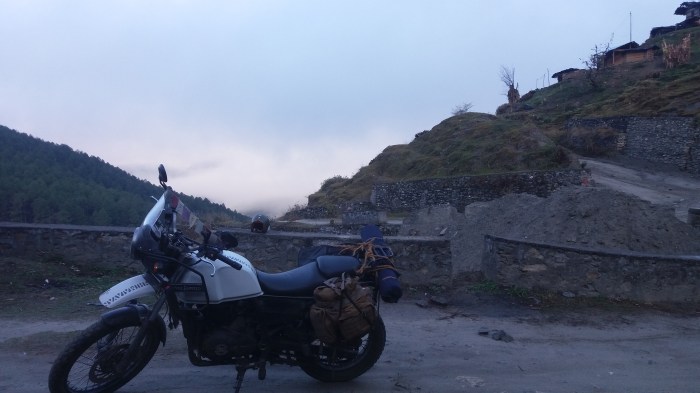
Moving up into higher country we had to sneak around some barricades and clear a few small villages before the sun touched us. Somehow it was a like a wild west movie, with an undertone of thrill and a hint of danger. A young twenty something indian with a balaclava over his face flagged us down at the junction at four in the morning, who ended up on the backseat of my bike.I had no idea if this was arranged and it felt rather strange to be carrying someone I didn’t know into the remote Himalayas, I later learned he was from the village and was trying to get home. This still didn’t explain why he was hitchhiking at some ungodly hour of the night, but it didn’t matter now. I lost the tail a couple times and fortunately he knew the way so we all convened close to Sankri where the roads peter out and become shepherds paths and goat walks. I surrendered my bike so it could be rode through a government checkpoint, measures had stepped up with security and the jaws of the curfew were closing, it was almost 7am. I hiked up a steep bank wearing my helmet and onto a terraced roadway to meet my bike further along, cleared of the checkpoint, no inane documents to fill in, no interrogation, no stranger danger hassle. In this unknown hamlet of colorful wooden houses, with chimney smoke coming from the roofs, roosters crowing and sheep dogs guarding their masters premises, I was suddenly elevated into the real Himalayas. The landscape strongly resembled the Rockies of western Canada while the stillness and quaint farm-holds reminded me of Newfoundland. A smile came to my face, as I took deep draughts of the deodar cedar and pine scented air.


We began the climb through the mud with the bike geared low up the switchbacks that seemed to rise eternally. The ‘road’ had been molded by the steel bobcat tracks and dozers that carried timber up and down the mountain. A crew of men packed into rugged pickup trucks with 4X4 drive bumped and jostled over the debris, and I put all my strength into keeping the bike upright, gripping the tank with my thighs and puttering along in first over the slick degraded surface. Sometimes my front wheel would get caught in a rut, forcing the back tyre to fall in tow, jerking my sideways and threatening to buck me off like a wild bronco, but surprisingly I didn’t drop the bike. Alas we pulled into a half moon space which buffered the edge of a precipitous slope, and parked the bikes behind a pile of sandbags. The views were stunning, so I snapped a few shots of the paddy gardens that ran along the topography of the mountain, the kind of views that appear in the national geographic magazines or planet earth documentaries.
I finally met the family in the wee morning hours, who looked a lot more of Tibetan or Chinese stock than India. Their pace of life was a lot more leisurely, breakfast took three hours and blended into lunch. I munched on millet rotis dipped in fresh honey from their traditional Himalayan hives. They owned a rabbit and two hairy sheepdogs, the bitch had lately given birth, and her two pups suckled on her nipples in the shade of a hut. A mama goat brayed for her kid, who was still feeble in the knees and quite cute. A rooster swaggered through the farmyard, and two of his harem followed keenly. One cow provided all the milk for the five of them, from which the family made pure sour curd with the whey left in, and fresh butter. This was the first time I had tasted newly churned butter. But the woman of the house wore no white apron and sky blue dress, or danced through flowery alpine meadows, she was garmented in an earth colored skirt, a wool overcoat, and plum colored bandana with a few gold piercings that accented her gracile face. Her dominions were the black soil plots of her high altitude garden nd the sun tanned heaths that stretch to the treeline of her queendom. A man sat on a rustic wooden bench pulling raw wool onto a spindle. Besides the antiquated pictures of Gandhi, I had never actually seen a man do this. Their two boy children were full of energy and took grate interest in one of my books about Indian farms. I taught them some English words as they repeated them through howls of laughter.
After some shut eye and a tour of the farm, we gathered a party for a hike up to Kedarkantha. Trekking up the scree and slash of some logging areas, then up to a series of mesas where we took a brief repose. The sky seemed bigger, the clouds looked whiter, there was an antediluvian atmosphere that enveloped this place. Itt felt like a good place to disappear from the world for awhile. The plateaus made perfect base camps for expeditions, and I took a pleasant catnap while propped up against the flat face of a boulder. We crossed some patches crusty snow, and several clear springs as the climb became more vigorous. I watched as a shepherd herded his sheep flock to nibble on what sparse grass had sprouted from the forest floor. Under the canopy of nut trees I gathered a handful of walnuts for a snack which grew between the coniferous species and oaks of this Himalayan Savannah, and drank from the streams, something I did not dare in other parts of India. Finally the peak was in view completely shrouded in snows, with a few brushy evergreens sticking out from its wintry mantle. There was no time to crest the summit before dark so we made our way back to the farm, enjoying the new color palette painted on the mountains during the sunset.
Back at the farm, supper was being prepared in the smoky kitchen hut. Upon entering, a man soaked my feet in a pan of hot herbal water, and washed them with utmost care. Then he proceeded with my hands, and poured a cup of the steaming water into my hands to wash my face. We sat with the extended family and neighbors, at least twelve of us in the small chamber of the kitchen while the maiden flapped small balls of dough between her hands and flattened them onto a skillet which were then fire at the mouth of a clay oven to make rotis which we ate copious amounts of with farm fresh vegetable soup and more creamy butter. I hit the hay pretty early because I was told we would need to leave the village in the darkness without being seen. I did not know whether to call the bluff or take it to heart. The roads here were not built for motorbikes, more suited to monster trucks, tanks or heavy logging vehicles. And to drive them on half a nights sleep in the womb of the night, riding precariously beside thousand foot drop offs, on a four hundred pound top heavy motorcycle did nothing to settle my heart. I mustered all my meditative powers to be here now and let those bridges be crossed in the morning, then stripped naked under the heavy blankets of my wooden tucket, alive and safe for now.
I wouldn’t go so far as saying the treacherous first two hours of the blind morning mountain ride was heroic, I had no one to save except myself, and there was no great myths being perpetuated or princess to swoon at the end of the road. It felt more like a vigorous workout at the gym than anything else, and I was exhausted by the time we reached pavement. I dropped the bike unceremoniously three times in deeply carved sloughs of muck. The third time I couldn’t get it up by myself, so the German girl gave a hand. My guide taunted me to keep 40km/h but it just did not seem realistic or possible. The savage side of me showed a little more when he wouldn’t stop this unhelpful encouragement, and I became quite angry which greatly affected my riding and my state of attention. I did not realize just the heights we had rose. A sweeping panorama of fog laden pines, and misty mountain valleys painted a mirage of the landscape that seemed surreal, but was so real. I saw almost no one on the roads, just a lonely bus with four or five people inside. I decided to travel solo for the trip back to Rishikesh. I needed to settle my mind and shift back into cruise control.
The corona virus scare was affecting everyone, and try as I may to let it roll of my shoulders, it was coming at me from all angles. Email letters from my neighbors and my kin carried the sense of urgency and warning to return home as soon as possible. India was going into lockdown and a 21 day curfew was being put into order. The freeways were more congested than the outgoing trip, with police roadblocks all the way through Dehradun, but I knew the back ways by nowmade good time in getting back to Tapovan to the relative safety of my hostel with a warm welcome to the Canadian rider. I extended my stay until the end of March, with the news of the impending political forecast. Interstate travel without police permission was forbidden, train stations were emptying out as their cars were used to haul food and medical supplies instead of people, news reports surfaced of Police officials beating lone men in the street with bamboo canes and making them roll on the pavement for leaving their houses without a permit. Only a few hole in the wall general shops were left open, even the farm produce trolleys and chai wallahs had packed up and headed inside. One person from each dwelling was allowed out to gather essentials, while more popular hotel chains forced people to the streets to clear room for quarantine patients. It was an unprecedented time in the countries history, as demands for lockdown started to roll out. India was about to become very quiet,

 the motorcycle mantras