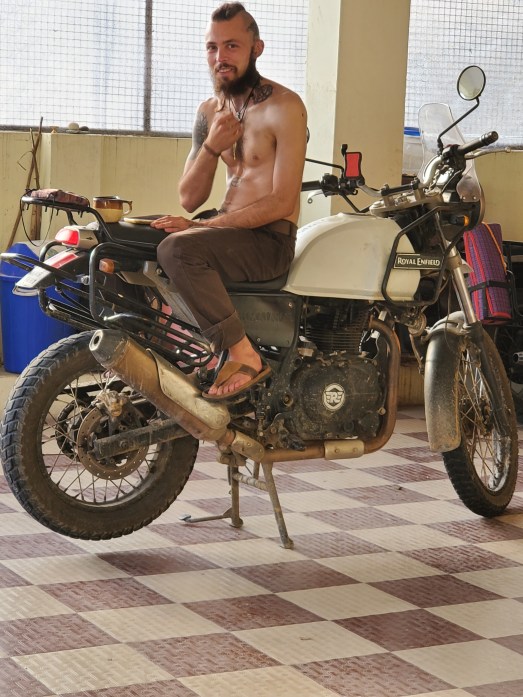
What can you do left when most of your basic civil rites are taken away, businesses bar their doors, families batten down the domestic hatches, social intimacy is considered taboo, and you are cooped up inside an international backpackers hostel in a foreign country… As India initiated for a 21 day lock-down over the entire country of 1.3 billion people, and several tens of thousands more tourists prepared to shelter in place, a term I much prefer to the word ‘quarantine’, I admit it was not the rite of passage towards exponential self healing and individual growth I had anticipated in the mother’s village. Is this how the Hero’s journey would end? A sad song, and an anti-climatic, snuffed out chapter of how I set the bike up on the center stand and simply waited it out? I can’t say yet if the events and experiences of the past two weeks have embellished the big trip as a whole, or if they have simply worked some magic on a different level beyond and behind the original intention of an all India tour.
For the most part I stayed put, content to write to my heart’s content, meditate on the state of affairs the world is experiencing, mingle with some travelers from countries I have never been to, nor met their respective citizens, and remediate the last four months on the road with a proper investigation of the deeper philosophy for my reasons why, and how I’ve done all this. Every morning I cooked huge pots of porridge with just about every fruit, nut and seed I could scavenge in the market, while these essential services allowed commerce during the liminal times of post sunrise until 10am. The folks in my hostel were liberal with sharing of calorie dense food, bitter black coffee brews made in a myriad of ways, and endless rounds of chai and chapatti. I even managed to find a cutthroat baba behind a crumbling concrete wall that shaved my head, spruced up my beard, and trimmed my mustache, all for the handsome price of 50 rupees. I noticed later in the mirror I had grown a few silver gray whiskers. Had I grown a little wiser? Or was this just rote for a 29 year savage gentleman who lives fast, and hangs out with old bastards? No matter, I liked what I saw looking back at me.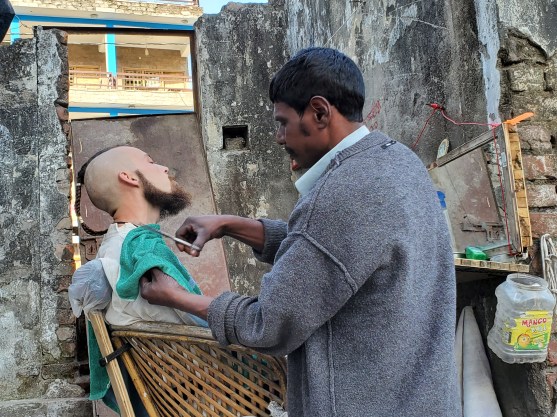
I shouldered the virtues of staying grounded in times of monumental change and danger, and belted up with the wizened responsibilities of taking competent action in this novel evolving world. While the wolf’s maw of global panic and pandemic remained the predominant narrative, I felt called upon as a man of this world, though indirectly and without solicitation, to defer back to an earlier more tribal humane(ity). People were uncomfortable, and it was easy to see how now more than ever we need to protect our kinfolk by any means we had available to us. It was time to dig into our bug-out bags and share what we had hoarded away for this moment. Thousands of people were dying of a disease that communally we did not know much about and that was hard for people to swallow. But we have been through this before; I think of e-coli scares in almost every country I’ve seen, SARS, Zika virus, Spanish flu, the Black Plague that decimated France, measles, mumps, chicken pox, and AIDS. This too shall pass, and the world will breathe a little freer, and it’s inhabitants will be that much more resilient towards the next sweeping ills. What I felt was in my capacity to offer those in my immediate surroundings was not gourmet foraged food and freshly hunted meats for the table, nor limitless streams of wealth for those with more frugal survivalist budgets, but the carefully perceived perspectives of story, and alliance. Suddenly I had an international family, and many allies to go through this. No one would experience these setbacks and nadirs alone. Deep teachings and sentiments have bubbled up from the bottom of the swamp of struggle, as everyone and their grandma has had their life fall apart, but not necessarily put back together again like Humpty-Dumpty in the fairy tale.
In the first week of the lockdown I took full advantage of the three hours in the morning where we could freely be in public to see a different face of India, one that perhaps no traveler has known for hundreds if not thousands of years. Once hustling bazaars, crowded city streets, and rambunctious urban noise was muted for an age and not a tuk-tuk or tea wallah disturbed this rare music of peace and quiet. On the fringes of Rishikesh’s souther’ villages that shared the border with Rajaji national wildlife reserve, leopards and elephants boldly came closer into town, no longer threatened by human traffic. I had heard that dolphins returned to the Mumbai harbors in absence of the ferry boats and cruise ships. The monkeys also got bold, and some were downright thieving. To walk home from a fruit stall with a bushel of bananas was an exercise in not getting mugged, only the simian outlaws used their teeth, not bullets. I surrendered several of the tree fruits to avoid a confrontation. I probably don’t get any good karma points for giving them up selflessly, but being wrenched by a hairy barbarian was not something I longed to experience, or write about. The dogs were hungry too, and I noticed a few sentimental travelers carrying around bags of kibble and pouring small mounds of the rations before their paws as they panted in the sun in the middle of every road. The shops in India all had metal garage style doors that opened upwards with loud, screeching wheels to announce the keepers attendance. These were all closed and padlocked now, which added to the destitution of the urban squares, like something out of an apocalypse movie.


I went to Laxman square where an army of cows ate cardboard from bike trolleys and street sweepers cleaned away their dung, they were walking lessons in anatomy of skin and bone, and the feeling of loneliness was most potent. The bridge between the two banks of the Ganges river was closing in a couple days but for all essential matters, there was nothing I could not there that wasn’t already on my side in Tapovan. People stood six feet apart in queue for the one working atm in town, and canvas covered army trucks barreled down the main road flanked with guards and road patrol. Some footage surfaced of police whacking down a few men with bamboo canes out on the streets after curfew. Others stood for forced selfies with cops, holding out signs printed in Hindi reading “I am an enemy of humanity”, both parties looking rather grim. I did not observe any of this myself in Rishikesh, and was told by a middle age Tibetan man selling handmade cookies on the street to support his family, that the river Ganga protected us all. Well, Rishikesh had no reported deaths or cases of the virus, and the water from the canals that irrigated all the surrounding farms eventually made its way into the food and our drinking water supply, so I supposed there was some merit behind it. I never had any intestinal problems or what they called ‘Delhi belly’ from drinking the tap water, but I took it from a drip filter if I could help it, or drank it boiled. The hostel prepared a meal plan for lunch and dinner to feed the twenty something of us that got stuck here, mostly rice, beans and subji (vegetables), but at least we wouldn’t go hungry. In fact, hunger was the least of my worries right now. India may be under quarantine but with nearly 60% of the population, read 1 billion people involved in agriculture, and the vast majority of them involved in the supply chain, there was always a little hole in the wall somewhere where I could eat, or a trolley to buy the simple everyday man’s vegetables. Now that India’s grand railway system ceased to operate, Prime Minister Modi used some of the trains to transport food and medical supplies across the country.
On the first day of curfew an order was made from Modi for all of India’s citizens stand on their balconies, porches and rooftops at a given time, and start clapping. The applause was for the service workers that risked their health and compromised their schedules to treat the infected, give free testing, and address the increasing numbers of symptomatic people at risk. Special train cars were remodeled and parked on the rails for quarantining those affected by the corona virus. Every newspaper article carried some strained influence of the disease, and for awhile, all of my e-mails were tinged with the same language. I followed closely what the Canadian embassy was doing and for the first week had the impression that maybe our Prime Minister had forgotten about Asia in his mental geographic map of the world. No repatriation efforts were made to bring home the 15,000 Canadians in India. I heard and read a lot of reports about hospitals filling up, three quarter of a million dollar fines for breach of the quarantine act, and military enforcement of mandatory self-isolation for travelers returning home. Somehow, a novel sars-like disease carried by a bat, and transmitted to a human in a village district of China had now created global repercussions more effective than any volcano, earthquake, world war, or terrorist attack. Who says one person can’t change the world?
Life indoors and behind doors was a trifle different for me. I’m a creature of big open country, wild spaces, the forest, the seaside, and the rolling country, and I was reserving my homebody nature for my cabin in the woods scenario back in Canada. I couldn’t possible feel as rooted and domestic here in a Hindu/Muslim society halfway across the world in a rented bedroom. But to my avowal, a few seeds of potent promise and mutual growth still cracked open and looked for the light. I shared coffee with a Colombian woman my age one morning, and found myself irresistibly drawn into her orbit. She has a levity and luminosity about her, like the sun that shines eternally down upon her equatorial city of Bogota. Her attitude was so as full bodied and perky as the coffee we drank, and she was out of her native South America to start a new life. For the next two weeks we had breakfast ‘dates’ in the communal kitchen of the hostel, read and unpacked chapter after chapter from ‘The Women Who Ran with the Wolves’, sat on the roof overlooking Rishikesh, told personal stories, took cat naps, and watched nature documentaries at night while she lay curled on my bed. We shared just about everything, It was easy, non-committal and probably just what I needed. A platonic affair in an exotic world, tinged with excitement and uncertainty.
I made friends with a Californian man hoping to get to Budapest in Hungary to retrieve some teaching credentials he had earned earlier, so he could continue his travels onward to Thailand where he taught English. We talked about everything under the sun; pioneering life, the art of cuisine, global disasters, world politics, yoga, his second life in Asia, and travel. His demeanor was stoic and even, yet he maintained a jovial attitude and didn’t take himself too seriously, I liked that. I learned a little more about my friend Jay from Boston, who had a career in the medical field. My gambles were definitely on his table if anything happened to me during the covid threat. He too had left the comforts of home, in search of a monastic life in Asia, did I say that already? If I did, it is probably worth mentioning again. We bonded over chats on the hostel balcony, and a few rides into town with him on pillion.

He accompanied me for a tattoo appointment I had made before the lock-down on the other side of the river. Getting there was more a tinge challenging because Laxman Jhula suspension bridge had closed, and jumping the barrier didn’t grock well with the cops. After a couple days of setting it up, we took the roadrunner out to Ram Jhula, another suspension bridge that allowed two wheeler traffic, and crossed before curfew set in. I had rarely felt such unique peace and freedom in my life, as I parked the bike in the middle of the narrow hanging bridge and looked down on the aqua blue flow of the most sacred river in Asia, while the dawn broke over the foothills. A man named Banjara welcomed me at the temple gate, inside where he had his tattoo parlor. The studio was close fitting but inviting, and he worked in the dark with lamplight for the whole piece, as per request. I had seen his sketchbook and portfolio a week before my escapade to the Himalayas, and trusted him completely with the art I had chosen. One of the Norse God Odin’s ravens wove of knots and Viking Runes, that would perch on my shoulder and stand on the side of my neck with an open beak. The ink was entirely vegan and made with extract of the American witch hazel bark and leaf, I thought it appropriate for my taste. I reclined on a letter bench, put on some Germanic music and let him go to work. With one snack break and five hours later, it was finished. The only pain came from the last stipulation details when the tattoo had already begun to scar and I had drained away all my endorphins, and adrenaline.
By now, the clock had struck four, and I thought it might pose a problem for getting back to the other side. I carefully put my helmet on over the tattoo, and we saddled up for the seven minute drive back to the hostel. Passing seven guards on the way, I did not make eye contact; passed the marketplace, across the bridge, both checkpoints, on to the main commuter road, passed a barricade where three police looked the other way, and then another who climbed into a jeep, and then into the desolate streets of the late afternoon, up a gravelly improvised bank where a sewage culvert flowed beneath, and up the alleyway leading to the hostel, safe and sound. We slid the white metal barred gate and tucked the bike inside. Mission impossible completed.
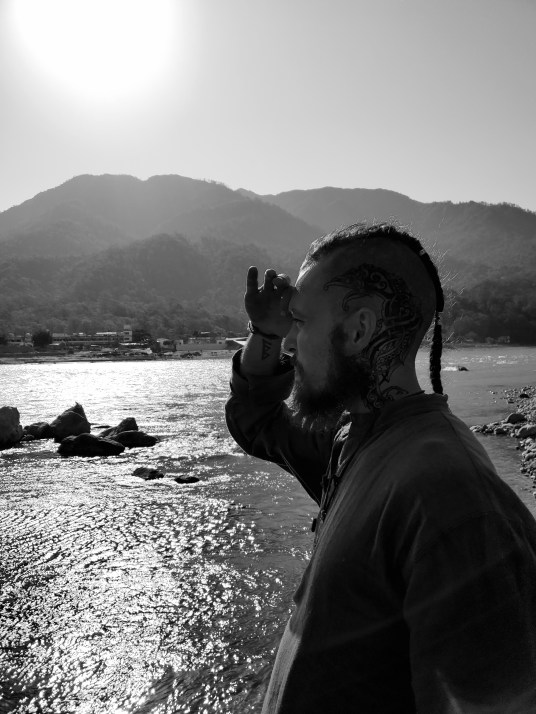
Besides this one foray and one later one micro journey to the Trivani Ghat on this side of the bridge, where a new impressive steel bridge was still being constructed, the trusses and beams were cinnamon red in the late morning, but it lacked a floor. The motor stayed cold and without baggage.  I thought I might be starving the motorcycle enthusiasts for decent road literature with nowhere to go, so I had to contend with the would be, and dreaming of trips, and for awhile live in someone else’s journey while I ate through Ted Simon’s second world trip in ‘Dreaming of Jupiter’ like a gourmet meal.
Whiling away the idle hours of an afternoon on the hostel balcony with my book, observing the life at the house across from us. A normal Indian family; the wife busied herself with drying grains on the concrete slab, gave baths, and swept their homestead, the husband was out of sight most days and I would occasional catch sights of their living room when the curtain blew aside, and saw a large tv inside, the mother washed pots and skillets, and five kids went through the motions of sedentary life, one of the older sons managed a shop beside the house selling some produce, snacks, betel chew, and the regular stuff that you find in every Indian general store, while after hours business was conducted underneath the large steel door, opened just an inch from the ground to slide money and contraband between giver and receiver. All the while the children played endless cricket matches, taunted their dog molly, who seemed to be at home as comfortable on their porch as our hostel foyer. The kids were very easy in the presence of a throng of westerners for neighbors, never ogling or showing overt interest either. From the second story I just observed the everyday mundane little things that didn’t matter for much. Cows, horses and donkeys left in the morning, bareback, and then returned in procession up the lanes at dusk, carrying heavy stones, grain, sand, or just being chased with canes by pushy owners. I watched a man seep a street for half and hour, then squat down and light his three piles of garbage on fire. I brought a kettle of black coffee onto the balcony, and served it in clear glasses to anyone who came to visit me, pretending I was a barista, while country music played from a speaker. You had to find ways to pass the time, but at least I wasn’t falling into vices.


It was unique to reside in this gentler side of India, I heard no news of terrorist attacks, bus accidents, street gang activity, or theft, these all needed people to play the part, and social distancing was the mantra of today. Life persevered, and one could find pockets of village life where nothing seemed to change at all. As I meandered up and down the maze like configuration of the Tapovan hills one morning, I noticed several postage stamp gardens growing sunflowers, garlic, onions and drumstick spinach, with a larger terraced cultivation, pigeoned in between three story resort buildings. A bent over woman clutched chaffs of wheat together in an hourglass fashion, bound at the waist like tourniquets of golden hair. A small waterfalls tumbled over mossy walls of purple orchids into a torrent that careened beneath a concrete bridge. If you closed your eyes and sat on the boulders, you could almost imagine it was a utopia in some old Scottish garden, almost…
I should say something about the multicultural community we had unwittingly become apart of in the hostel. I was one of two Canadians, the other, Jean-Francois from Quebec was a massage therapist and earned the nickname mr. Green. I never asked why. There was also mr. Boston, and my Californian friend from the US of A. The women were from Turkey, Colombia, Russia, Brazil, Japan, South Korea and the Netherlands. A young couple trying to get home came from Germany, and a pack of guys from Uruguay, Peru, Venezuela, Spain, Italy, Switzerland, Scotland, Poland, Israel and Albania, then there were four Indian staff, all in their 20’s, and two India guys from smaller villages who had school projects and family lives. We represented a broad spectrum of bias, opinions and customs. How the cards could fall just so, that each of us represented a unique part of the world, even the Americans were from opposite coasts. And besides my Quebecois neighbor, I spoke no fluent french anymore. I remember the night we all gathered on the rooftop, it goes without saying we were not six feet apart, Modi had requested of his nation for the lights to be switched off, in every city, town and village at 9pm sharp. Candles and torches were fired, and thousands of beacons of light wavered over Rishikesh, while a few bold souls lit colorful fireworks, and popcorn crackers from their terraces. The howls and chanting from thousands of people resounded four storeys up. The air was charged with such potent energy it felt like waves of electricity conducted through the blackened night air. It was another of these non verbal support cues for the relief workers, and it seemed to lift the mood quite intentionally.
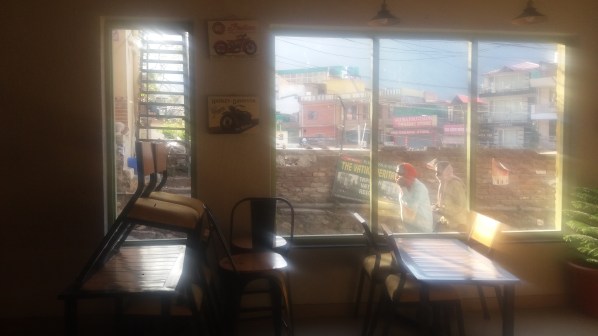
My flight was canceled home to Canada on April 15, so I spent three hours in a cafe waiting for a human to talk to, in order to change the itinerary. The cafe itself was quite ok too, one of those retro joints with quirky coffee signs and wooden motorcycle plaques of Harleys and Indians on the wall. A couple leather couches and a glass display case filled with pastries even, it was a small connection to the country roadhouses back home, maybe even better, so I didn’t mind wasting a morning there. I was able to rebook the ticket for minus seven days, so I was now to board on the 8th, which left a lot less time to return the bike, but perhaps I could get it on a train in Haridwar as cargo. This flight was canceled a few days later, so I threw out the idea of riding back to Bombay. For awhile I was in limbo, not really sure how I would be able to get me and the bike returned home. An email came one morning from the high consular of Delhi, posting that the first leg of repatriation flights would leave during the first weekend of April. This was in three days, but there were not yet any negotiations with road police for interstate travel. To ride 1700km on any given day on India’s road meant passing several barricades, check-posts, police booths, and borders. To do it under a nationwide lock-down would be asking for more trouble than I could chew, and it didn’t feel good. The railroads were closed too, so that idea went out the window. I could leave the bike and sort it out later with the hostel when I got home, but I would not have my Indian sim card that long. I mulled it over, but in the end decided against making any big moves right away. The process of securing a flight was through a convoluted system of online application and individual eligibility. An agent would be in personal contact with each applicant, and advised on which flight they would be feasible to take. A booking would be made, starting at a minimum recovery cost of $2,900 not including travel to the airport, food on board and lodging in overpriced hotels in Delhi, Mumbai, Bangalore or Punjab while you waited through medical testing and complex bureaucracy to sort you out. The situation at home didn’t seem rosy either. The government was imposing fines of three quarter of a million dollars for leaving the house during a mandatory 14 day isolation phase. That would make nearly a month and a half of dormancy, while I came down from a long winded motorcycle tour of 10,000km. The military was called in to patrol the streets, and try as I may, I simply could not see myself living in that Canada, it was one I didn’t care to befriend. So I opted to wait it out until India’s lockdown ended and made a new goal to return before Mothers Day weekend, post quarantine and all. Maybe India was holding out on me, and still held a few diamonds to unearth. My Canadian existence; the farm, the M.C., the back country, and life at last had to wait a little longer.

 the motorcycle mantras
Sending hugs to you and your hostel mates. I really enjoy your stories, descriptions and photos. Quite the adventure you are on. If the universe delays your passage home to Canada again I am sure you will make the best if things and return when things fall into place easily..
create another great day!
Marilyn.
LikeLike
I am indebted in gratitude for the generosity of your words. I believe we met at brewmasters, is it true?
Cheers
LikeLike
You are welcome, Nope, not Brewmasters but it sounds yummy. I am Peter’s wifey..Marilyn ..he also keeps me updated on your journey and Bike updates.
LikeLike
Ah, Marilyn. Nice to connect through here. I’m looking forward to seeing Perth again, and unveiling the nighthawk, visiting with you and Pete.
LikeLike
Ah, yes it’s great to keep in touch, Perth is doing well, no major issues with virus.. just drugstores, and grocery, gas stations, some drive throughs are open so basics are covered. We are looking forward to seeing you also.
LikeLike
Fair winds my friend, stay well why you wait out the storm. Canada is discouraging motorcycle travel.
LikeLike
Cheers Squatch, I ride with the Old Bastards with me in spirit on every road!
LikeLike